
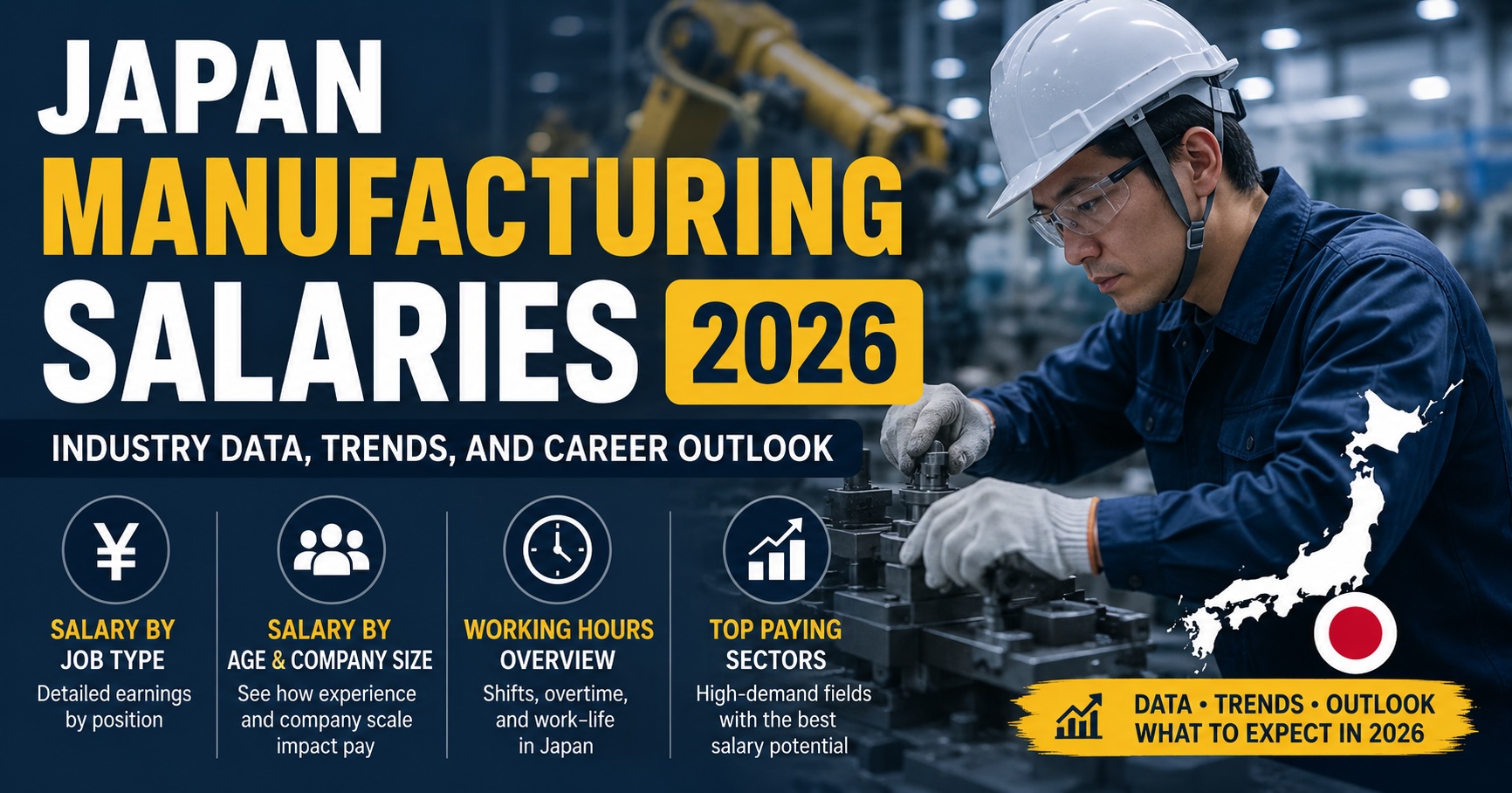
Japan is known worldwide for manufacturing.
From automobiles and industrial robots to semiconductor equipment and precision machinery, manufacturing remains one of the country’s most important industries.
Companies such as Toyota, Honda, Hitachi, Panasonic, Mitsubishi Electric, Keyence, and Fanuc are recognized around the world.
But how much do people working in Japan’s manufacturing industry actually earn?
This article breaks down manufacturing salaries in Japan by job type, age, company size, working hours, and industry segment while examining the trends shaping the sector in 2026.
Exchange rate used throughout this article: ¥150 = $1 USD
💰 What Is the Average Manufacturing Salary in Japan?
Quick Answer
Typical manufacturing salaries in Japan range from approximately ¥3.5 million–¥7 million ($23,000–$47,000) per year. Japan’s overall average salary across all industries is approximately ¥4.6 million ($30,000) per year.
Manufacturing salaries vary considerably depending on:
- Company size
- Location
- Experience
- Job role
- Industry specialization
While some employees at major manufacturers earn substantially more, many workers at small and medium-sized companies earn below the national average.
👷 Manufacturing Salaries by Job Type
One of the biggest factors affecting income is job role.
| Position | Typical Annual Salary |
|---|---|
| Production Worker | ¥3M–¥5M ($20,000–$33,000) |
| Machine Operator | ¥3M–¥5.5M ($20,000–$37,000) |
| Maintenance Technician | ¥3.5M–¥6M ($23,000–$40,000) |
| Manufacturing Engineer | ¥4M–¥8M ($27,000–$53,000) |
| Production Supervisor | ¥4.5M–¥7M ($30,000–$47,000) |
| Factory Manager | ¥5M–¥10M+ ($33,000–$67,000+) |
💡 Key Insight
The biggest salary difference in Japanese manufacturing is often not age. It is company size. A factory manager at a large automotive manufacturer may earn significantly more than someone doing a similar job at a small supplier.
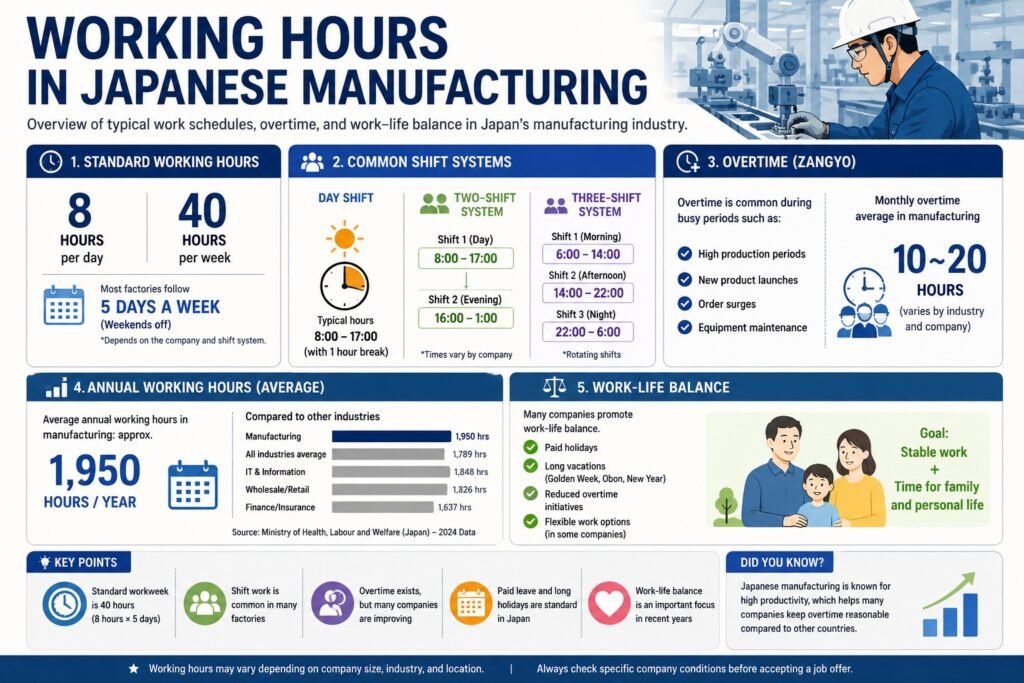
⏰ Working Hours in Japanese Manufacturing
Salary is only part of the picture.
Working hours are also important.
Most manufacturing jobs operate on:
- Standard daytime schedules
- Two-shift systems
- Three-shift systems
depending on production requirements.
A typical schedule is:
- 8 hours per day
- 40 hours per week
- Weekends off (depending on factory operations)
Overtime is common during busy periods, particularly in:
- Automotive manufacturing
- Semiconductor equipment
- Factory automation
- Electronic components
Because overtime is generally paid, total annual compensation can sometimes be noticeably higher than base salary alone.
👨💼 Manufacturing Salaries by Age
Income usually rises with experience, although the pace varies significantly by employer.
| Age Group | Typical Annual Salary |
|---|---|
| 20s | ¥2.5M–¥4.5M ($17,000–$30,000) |
| 30s | ¥3M–¥6M ($20,000–$40,000) |
| 40s | ¥3.5M–¥7M ($23,000–$47,000) |
| 50s | ¥3.5M–¥8M ($23,000–$53,000) |
While salaries generally increase with age, company size and specialization often have an even greater impact.
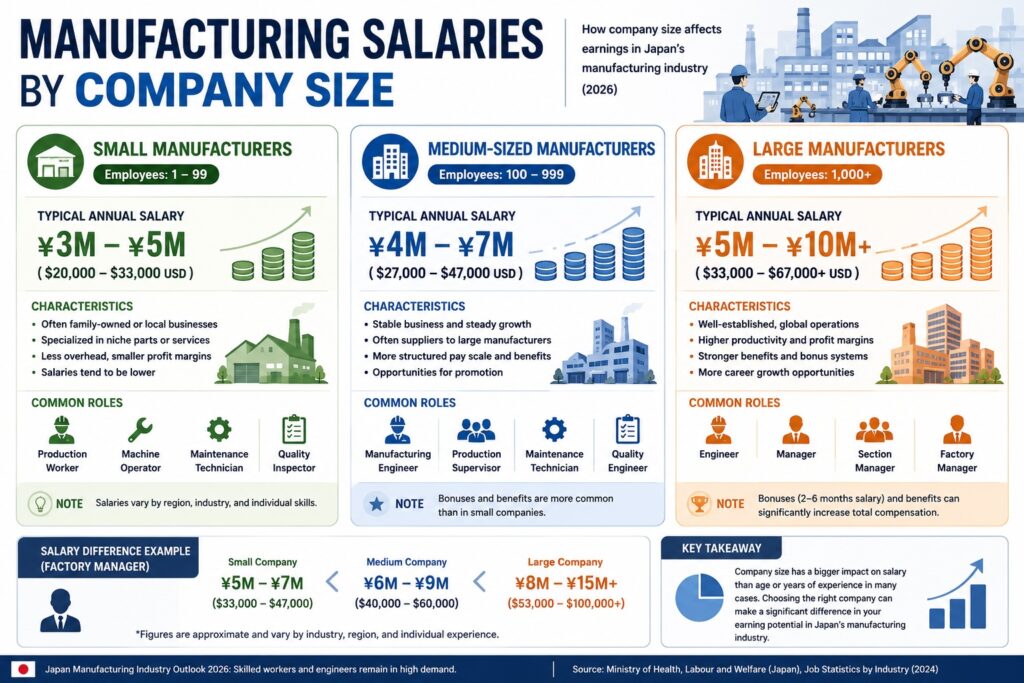
🏭 Manufacturing Salaries by Company Size
Company size has a major influence on compensation.
Small Manufacturers
Typical salary: ¥3M–¥5M ($20,000–$33,000)
Common areas include:
- Precision machining
- Metal processing
- Custom parts manufacturing
- Industrial subcontracting
Medium-Sized Manufacturers
Typical salary: ¥4M–¥7M ($27,000–$47,000)
Many operate as suppliers to larger corporations.
Large Manufacturers
Typical salary: ¥5M–¥10M+ ($33,000–$67,000+)
Examples include:
- Toyota
- Honda
- Hitachi
- Panasonic
- Mitsubishi Electric
Bonuses and benefits can significantly increase total compensation.
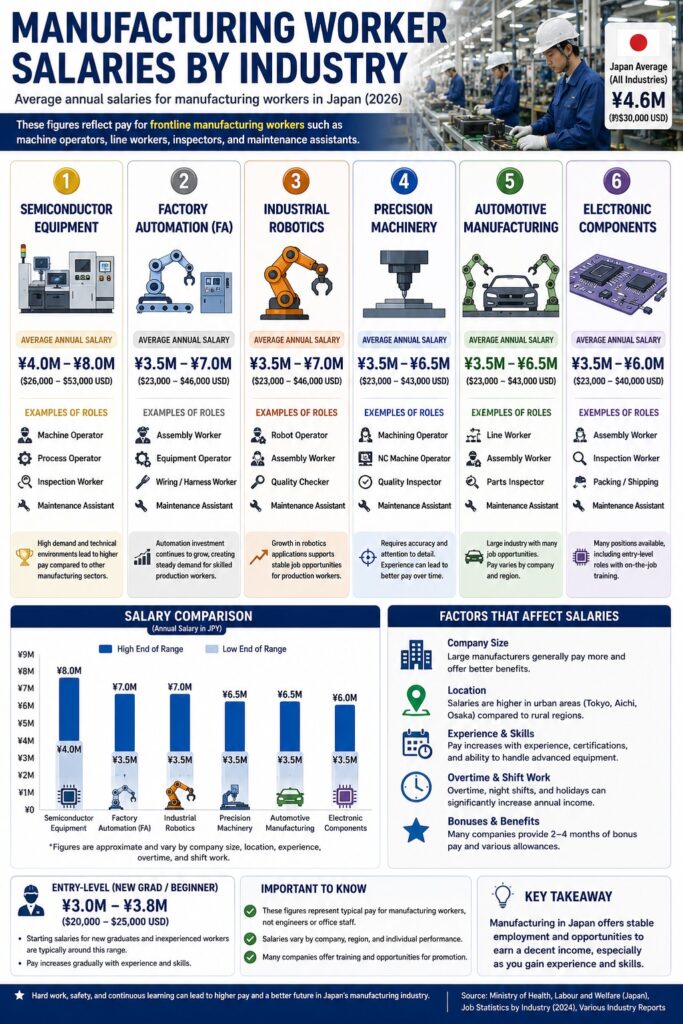
📈 Highest-Paying Manufacturing Segments
Not all manufacturing sectors pay equally.
Some of the highest-paying fields include:
🥇 Semiconductor Equipment
🥈 Factory Automation (FA)
🥉 Industrial Robotics
🏅 Precision Machinery
🏅 Automotive Engineering
🏅 Electronic Components
These sectors benefit from strong global demand and highly specialized technical skills.
📊 Manufacturing Salary vs Japan’s Average Salary
Japan’s national average salary is approximately:
¥4.6 million ($30,000 USD)
Many manufacturing workers earn salaries near this level.
However, engineers, supervisors, and specialists often earn considerably more.
Manufacturing remains one of Japan’s better-paying traditional industries, although there are large differences between employers.
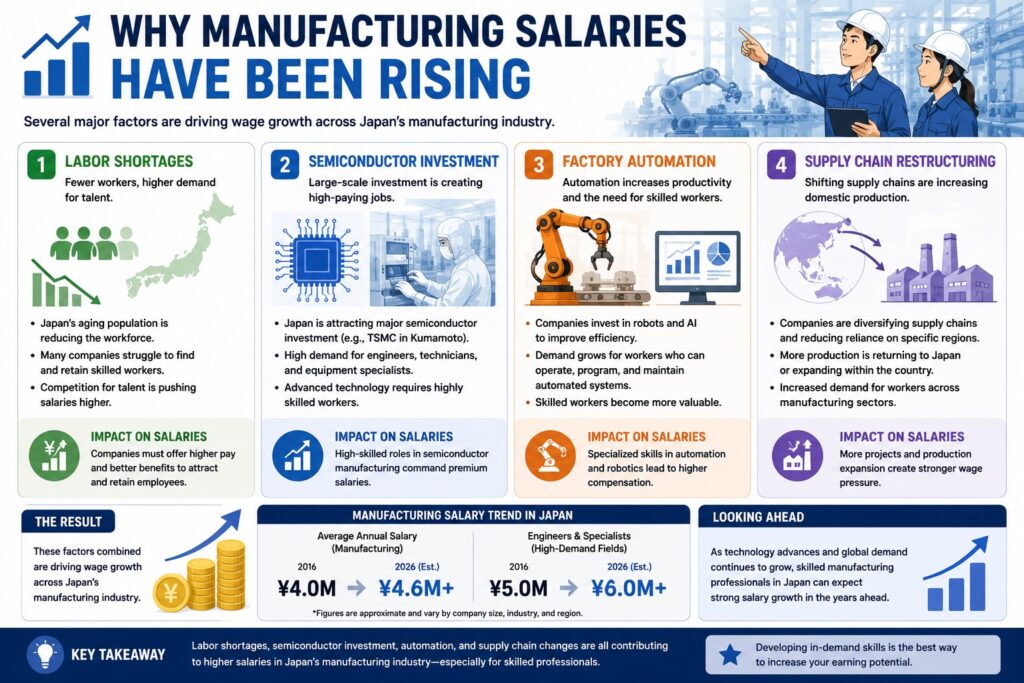
🚀 Why Manufacturing Salaries Have Been Rising
Several factors have supported wage growth in recent years.
Labor Shortages
Japan’s aging population has created labor shortages across many industries.
Manufacturers increasingly compete for skilled workers.
Semiconductor Investment
Japan has attracted major semiconductor investment in recent years.
This has increased demand for engineers, technicians, and equipment specialists.
Factory Automation
Companies continue investing in robotics and automation to improve productivity.
This has increased demand for workers with technical expertise.
Supply Chain Restructuring
Many manufacturers are diversifying supply chains and expanding domestic production capacity.
This has created additional demand for skilled employees.
🔮 Which Manufacturing Jobs Have the Best Outlook?
Several areas appear particularly promising.
Semiconductor Equipment
Demand continues to grow as chip production expands globally.
Industrial Robotics
Japan remains one of the world’s leading producers of industrial robots.
Factory Automation
Automation remains a long-term growth trend.
Advanced Manufacturing Engineering
Workers with engineering expertise are generally in strong demand.
📅 Outlook for 2027 and Beyond
Manufacturing remains one of Japan’s most important industries.
While wage growth is unlikely to be dramatic across the entire sector, demand for skilled technical workers is expected to remain strong.
Workers with expertise in:
- Robotics
- Automation
- Semiconductor equipment
- Precision machinery
- Production engineering
are likely to enjoy the strongest salary growth opportunities.
✅ Key Takeaways
- Typical manufacturing salaries range from ¥3.5M–¥7M ($23,000–$47,000).
- Company size has a significant impact on earnings.
- Engineers and managers generally earn more than production workers.
- Semiconductor, robotics, and factory automation sectors tend to offer the highest compensation.
- Manufacturing salaries often sit near or above Japan’s national average salary.
- Technical skills remain one of the strongest drivers of wage growth.