
Many people naturally focus on salary when comparing life between countries.
That is completely understandable.
Salary is easy to compare.
What is much harder to compare is how far that income actually goes.
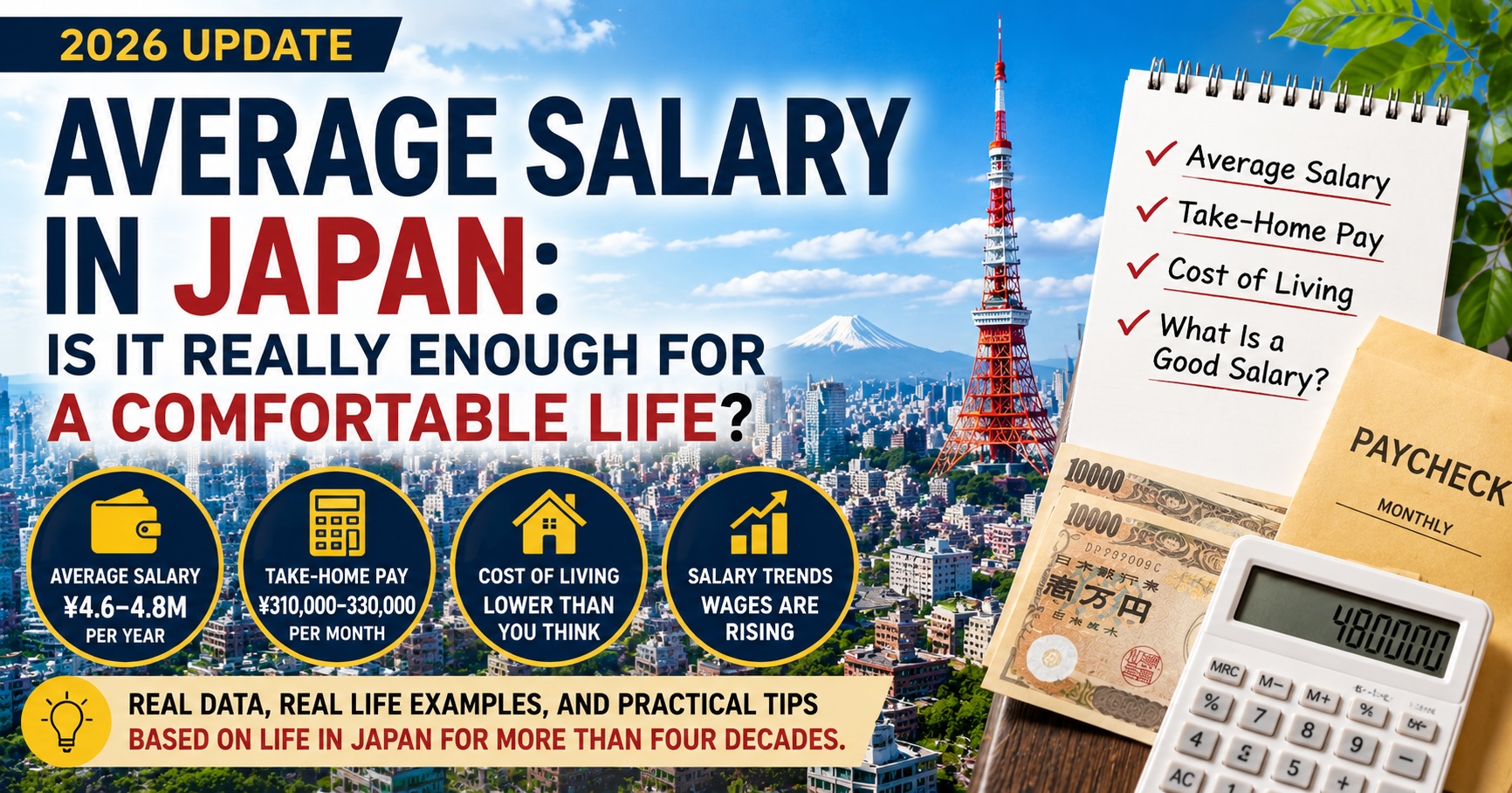
Recent estimates generally place Japan’s average annual salary at roughly ¥4.6–4.8 million per year (approximately $31,000–32,000 USD).
Compared with countries such as the United States, Canada, Australia, or the United Kingdom, that number can appear surprisingly low.
Yet millions of people across Japan rent apartments, travel domestically, enjoy hobbies, eat out regularly, and save money every month.
After living in Japan for more than four decades, I have found that the balance between income and everyday costs often matters more than salary alone.
Looking at both sides of the equation can lead to a very different picture of life in Japan.
Exchange rate used throughout this article: ¥150 = $1 USD
What Is the Average Salary in Japan in 2026?
Recent estimates generally place Japan’s average salary at approximately:
- ¥4.6–4.8 million per year
- ¥383,000–400,000 per month
- Approximately $31,000–32,000 USD annually
This figure includes workers across all industries, regions, and age groups.
However, averages do not always represent the typical worker.
To understand income in Japan more accurately, it is also important to look at the median salary.
Average Salary vs Median Salary
The average salary is often the headline figure reported in articles and statistics.
The median salary tells a different story.
The median represents the worker in the middle of the income distribution.
| Metric | Annual Income |
|---|---|
| Average Salary | ¥4.6–4.8 million |
| Median Salary | Approximately ¥3.8–4.0 million |
This means many Japanese workers earn less than the national average.
That does not necessarily mean they struggle financially.
It simply highlights why averages should be viewed alongside real living costs.
What Is the Average Salary After Tax?
One of the most common questions people ask is how much of that salary actually reaches your bank account.
A typical employee earning Japan’s average salary will usually pay:
- Income tax
- Resident tax
- Health insurance
- Pension contributions
- Employment insurance
A simplified example looks like this:
| Item | Amount |
|---|---|
| Annual Salary | ¥4.8 million |
| Monthly Gross Income | ¥400,000 |
| Typical Take-Home Pay | ¥310,000–330,000 |
Actual figures vary by location and family situation, but this provides a realistic estimate for many workers.
Salary by Age in Japan
Income generally rises with experience, although the exact amount depends on industry, company size, and location.
| Age Group | Typical Annual Salary |
|---|---|
| 20s | ¥2.5M–¥4.5M |
| 30s | ¥3.0M–¥6.0M |
| 40s | ¥3.5M–¥7.0M |
| 50s | ¥3.5M–¥8.0M+ |
For a deeper breakdown, see:
Most Japanese Earn Less Than You Think – Salary by Age (2026)
Salary by Industry in Japan
Industry often has a larger impact on earnings than age.
| Industry | Typical Annual Salary |
|---|---|
| Retail | ¥3M–¥5M |
| Hospitality | ¥3M–¥5M |
| Manufacturing | ¥3.5M–¥7M |
| Information Technology | ¥3.5M–¥9M |
| Finance | ¥4M–¥12M+ |
For a detailed look at manufacturing pay, see:
Japan Manufacturing Salaries in 2026: Industry Data, Trends, and Career Outlook
What Is Considered a Good Salary in Japan?
This is one of the most searched questions about Japanese salaries.
| Annual Salary | General Impression |
|---|---|
| ¥3 million | Basic single-person lifestyle |
| ¥4.6–4.8 million | National average |
| ¥6 million | Comfortable lifestyle with savings potential |
| ¥8 million | Above-average earner |
| ¥10 million+ | High-income household |
For many people, ¥6 million per year is where life starts to feel noticeably more comfortable.
For a detailed breakdown, see:
Is ¥6 Million ($40,000) a Good Salary in Japan? (2026 Guide)
Can You Live Comfortably on Japan’s Average Salary?
For most people, the answer is yes.
You probably will not become wealthy on Japan’s average salary.
However, many workers can still rent an apartment, travel domestically, enjoy hobbies, eat out regularly, and save money.
The reason becomes clearer when you look at living costs.
For a detailed breakdown of everyday expenses, see:
Living Cost in Japan for Foreigners (2026 Guide): Real Monthly Budget Breakdown
Why Japan’s Average Salary Often Goes Further Than Foreigners Expect
Housing is often cheaper than many foreigners expect.
Restaurant meals are relatively affordable.
Public transportation reduces the need for car ownership.
Healthcare costs are generally predictable.
When combined, these factors often allow average earners to enjoy a comfortable lifestyle.
- Average Rent in Japan (2026): Why Tokyo Is Cheaper Than Many Americans Expect
- Tokyo Apartment Rent (2026): Average Cost by Area
- Food Cost in Japan (2026): Why Eating Well Costs Less Than Many Americans Expect
Can You Live in Japan on $3,000 Per Month?
This question appears frequently in search results.
$3,000 per month is approximately ¥450,000.
For many single people, that income is enough to support a comfortable lifestyle in Japan.
It can often cover:
- Rent
- Food
- Utilities
- Transportation
- Entertainment
- Savings
Why Salaries Are Rising in Japan
For many years, Japan was known for slow wage growth.
Recently, that trend has begun to change.
Labor shortages, inflation, and competition for workers have pushed wages higher.
Recent wage negotiations have produced some of the largest pay increases seen in decades.
This trend is particularly noticeable in technology, engineering, finance, and advanced manufacturing.
What Surprised Me After Living in Japan for More Than Four Decades
After living in Japan for more than four decades, one thing has consistently stood out to me.
When comparing life between countries, it is natural to focus on salary first.
However, once you begin looking at both income and living costs together, a different picture often emerges.
Being able to walk to supermarkets, use reliable public transportation, enjoy affordable restaurants, and live in a safe environment all contribute to quality of life.
These things rarely appear in salary statistics.
Yet they often matter just as much as income itself.
That is why the balance between salary and cost of living is often more important than salary alone.
Frequently Asked Questions
What is the average salary in Japan per month?
Japan’s average salary is approximately ¥383,000–400,000 per month before deductions.
What is the average salary in Japan after tax?
Many workers earning the national average salary take home approximately ¥310,000–330,000 per month.
What is the median salary in Japan?
The median salary is estimated to be approximately ¥3.8–4.0 million per year.
Is ¥6 million a good salary in Japan?
Yes. ¥6 million per year is generally considered above average and can support a comfortable lifestyle in most parts of Japan.
Can foreigners live comfortably in Japan on an average salary?
In many cases, yes. Housing, transportation, and food costs are often lower than many people initially expect.