
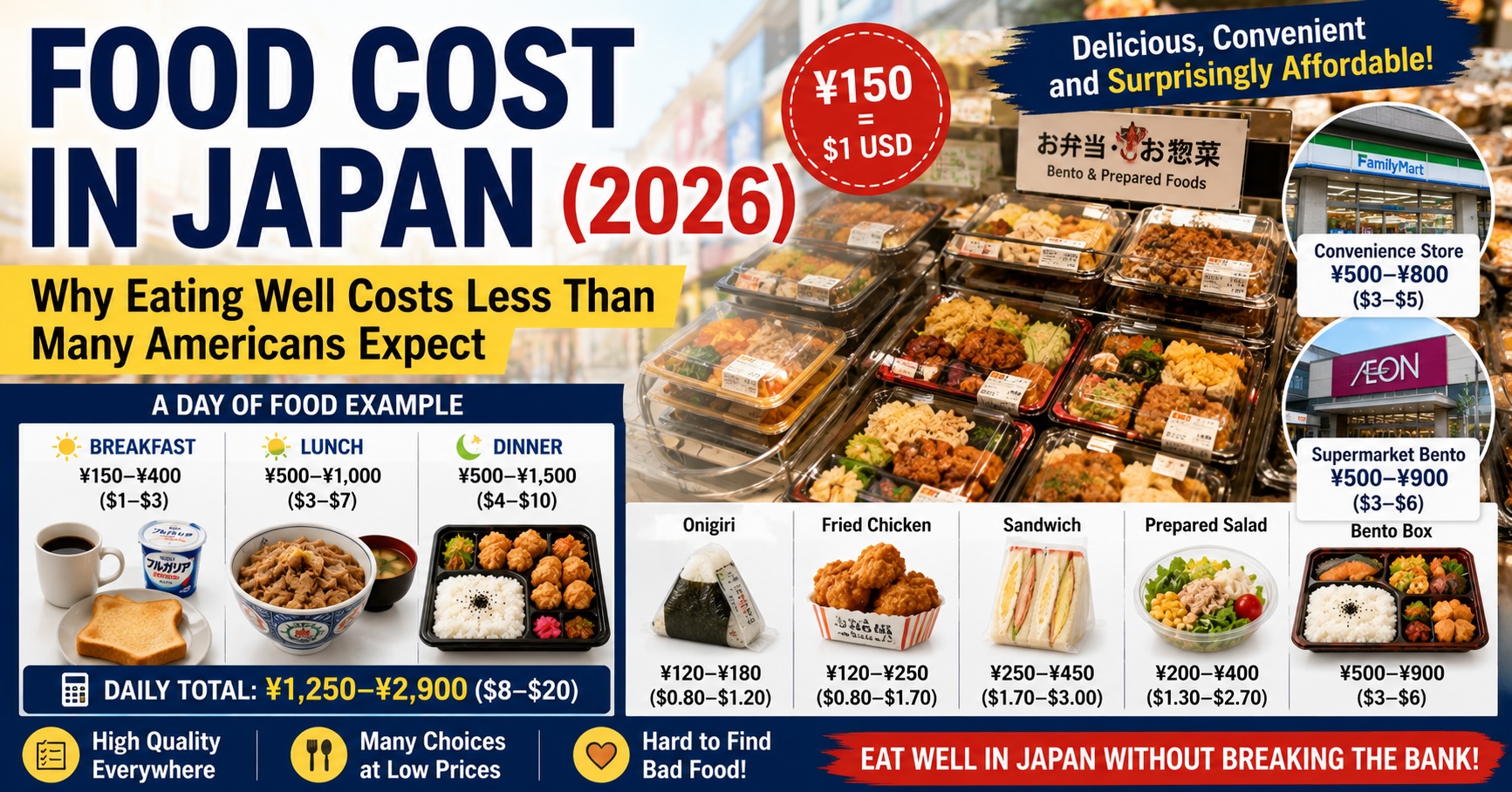
Many foreigners assume food in Japan must be expensive.
That assumption makes sense.
Japan is famous for sushi, wagyu beef, luxury fruit, and Michelin-starred restaurants.
Those things certainly exist.
But they are not how most people eat every day.
The surprising reality is that everyday food in Japan is often much more affordable than visitors expect.
After living in Japan for more than four decades, one thing I still appreciate is how easy it is to eat reasonably well without spending a fortune.
The question is not whether luxury food is expensive.
The real question is why ordinary food remains relatively affordable.
Exchange rate used throughout this article: ¥150 = $1 USD
How Much Does Food Cost in Japan?
Food costs vary depending on where you live and how often you cook.
For a typical single person, monthly food expenses often fall into these ranges:
| Lifestyle | Monthly Food Cost |
|---|---|
| Budget-conscious | ¥30,000–¥45,000 ($200–$300) |
| Average lifestyle | ¥45,000–¥75,000 ($300–$500) |
| Frequent dining out | ¥75,000–¥120,000+ ($500–$800+) |
Many foreigners are surprised that food costs can remain relatively reasonable even in Tokyo.
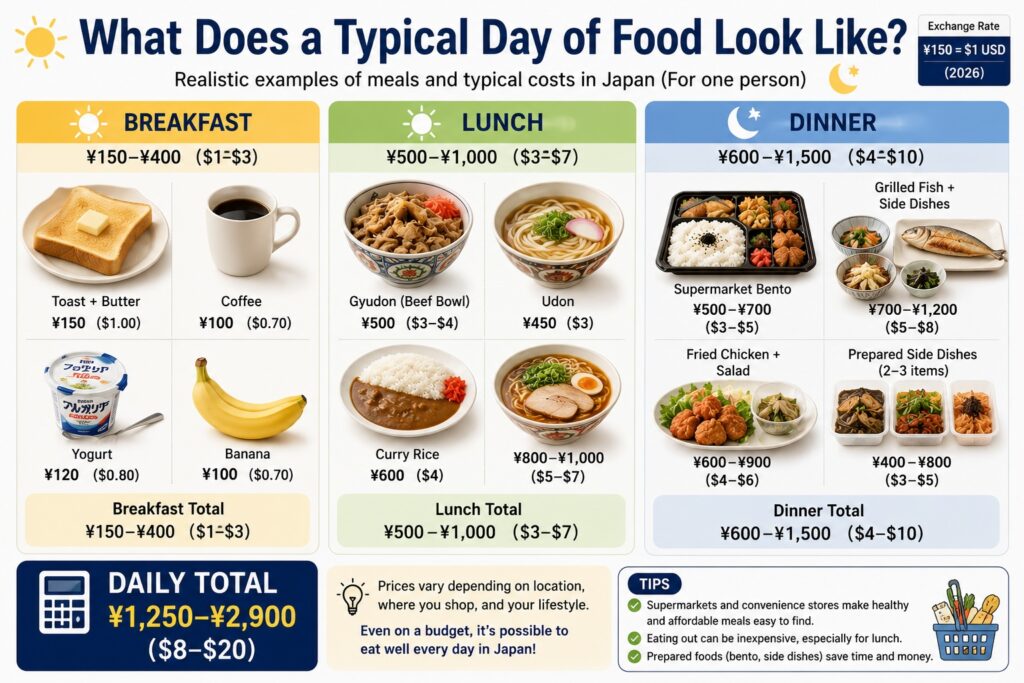
What Does a Typical Day of Food Look Like?
One reason people overestimate food costs in Japan is that they imagine every meal involves sushi or restaurants aimed at tourists.
A more typical day might look like this:
Breakfast
- Toast
- Coffee
- Yogurt
Cost: roughly ¥150–¥400 ($1–$3)
Lunch
- Gyudon
- Udon
- Curry rice
- Ramen
Cost: roughly ¥500–¥1,000 ($3–$7)
Dinner
- Supermarket bento
- Prepared side dishes
- Home-cooked meal
Cost: roughly ¥600–¥1,500 ($4–$10)
For many people, total daily food spending falls between:
¥1,250–¥2,900 ($8–$20) per day
depending on lifestyle.
The Biggest Difference: Japan Has a Strong Prepared-Food Culture
This is one of the things many foreigners underestimate.
Japanese supermarkets do not simply sell ingredients.
They also sell complete meals.
A typical supermarket may offer:
- Bento boxes
- Fried chicken
- Tempura
- Grilled fish
- Croquettes
- Salads
- Simmered vegetables
- Sushi
Typical prices are often surprisingly reasonable:
| Item | Typical Price |
|---|---|
| Onigiri | ¥120–¥180 ($0.80–$1.20) |
| Sandwich | ¥250–¥450 ($1.70–$3.00) |
| Bento Box | ¥500–¥900 ($3–$6) |
| Fried Chicken | ¥120–¥250 ($0.80–$1.70) |
| Prepared Salad | ¥200–¥400 ($1.30–$2.70) |
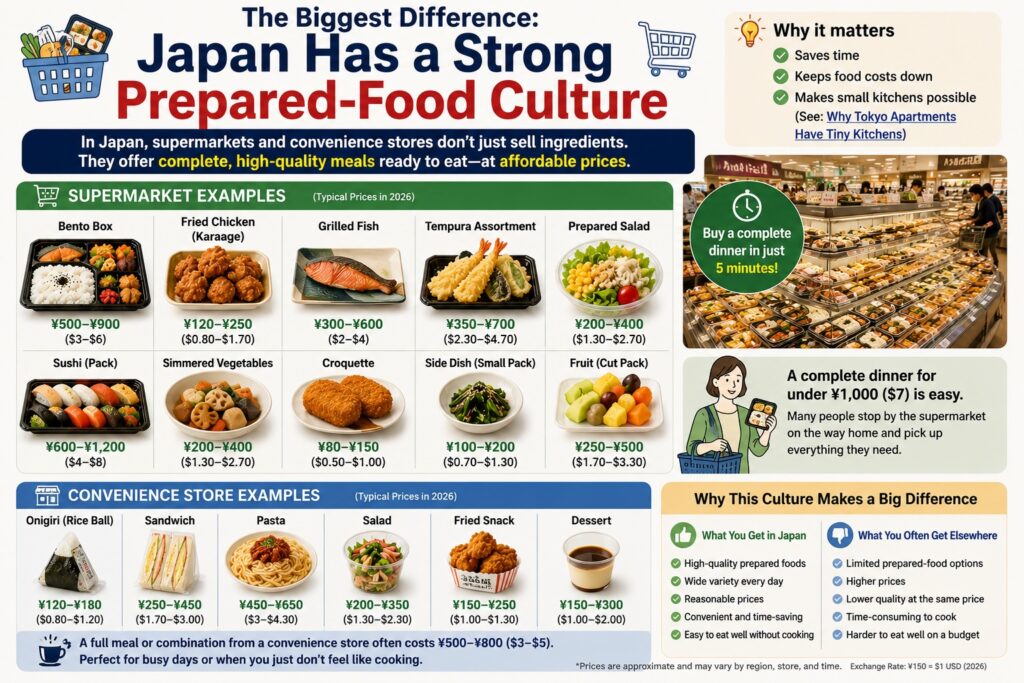
Many people can buy an entire dinner for under ¥1,000 ($7) without cooking.
This convenience is one reason Japanese apartments often work well with relatively small kitchens.
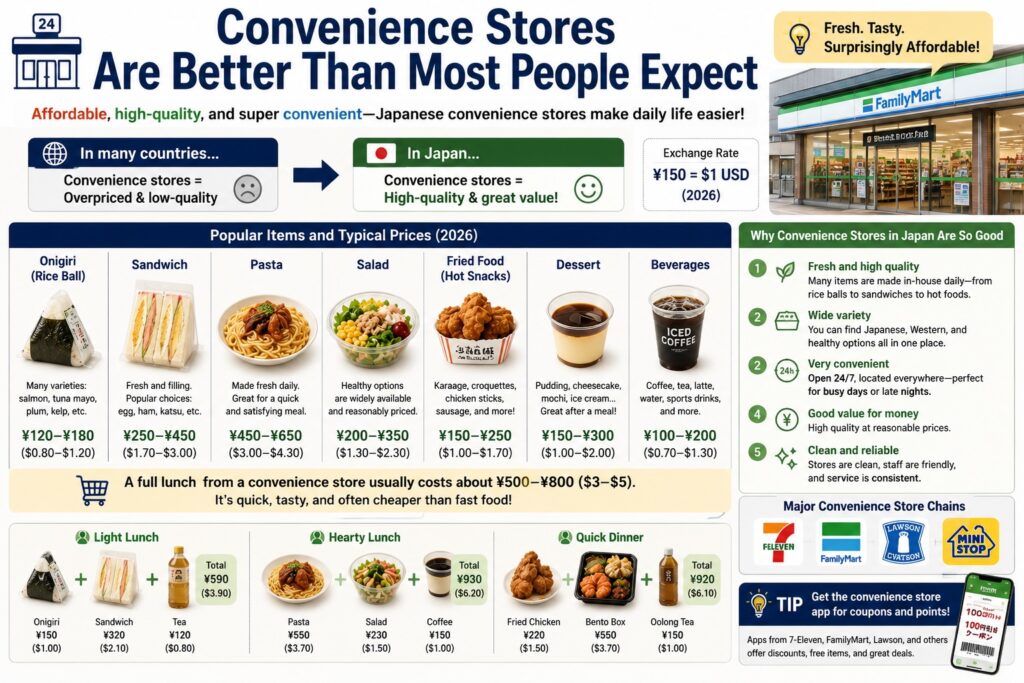
Convenience Stores Are Better Than Most People Expect
In many countries, convenience stores are associated with overpriced snacks and low-quality food.
Japan is different.
Convenience stores commonly sell:
- Fresh rice balls
- Sandwiches
- Pasta dishes
- Salads
- Hot snacks
- Desserts
A quick lunch from a convenience store often costs around ¥500–¥800 ($3–$5).
While it may not be the absolute cheapest option, it is often much better than visitors expect.
Eating Out Is Often Surprisingly Affordable
One of the biggest surprises for newcomers is restaurant prices.
Meals such as:
| Meal | Typical Price |
|---|---|
| Gyudon | ¥400–¥700 ($3–$5) |
| Udon | ¥400–¥800 ($3–$5) |
| Curry Rice | ¥500–¥900 ($3–$6) |
| Ramen | ¥700–¥1,200 ($5–$8) |
can be found throughout Japan.
Many people assume eating out regularly must be expensive.
In reality, a simple restaurant meal can cost little more than a fast-food meal in many Western countries.
Another Surprise: It Is Surprisingly Hard to Find Bad Food
This may sound strange, but many visitors notice the same thing.
In Japan, even inexpensive restaurants often maintain a reasonable standard of quality.
That does not mean every restaurant is amazing.
However, it is surprisingly uncommon to walk into a random restaurant and have a genuinely bad meal.
Competition is intense.
Customers have many choices.
As a result, even relatively inexpensive restaurants often provide food that is fresh, consistent, and satisfying.
For many visitors, this becomes one of the most memorable aspects of daily life in Japan.
Food Is Only Part of the Story
Food costs are important.
But they are only one piece of the puzzle.
Many Japanese neighborhoods allow residents to walk to:
- Supermarkets
- Convenience stores
- Restaurants
- Pharmacies
- Clinics
- Train stations
This makes daily life both convenient and efficient.
In many cases, people can buy dinner on the way home without making a special trip.
That convenience saves both time and money.
What Still Impresses Me After Living in Japan for Decades
After living in Japan for more than 40 years, one thing still stands out.
Good food is everywhere.
Whether you visit a supermarket, a convenience store, a small local restaurant, or a chain restaurant, it is usually easy to find something satisfying at a reasonable price.
Premium dining certainly exists.
But what makes Japan special is not the expensive food.
It is the accessibility of decent everyday food.
That is something many visitors do not fully appreciate until they actually live here.
Is Food in Japan Expensive in 2026?
Compared with many developed countries, everyday food in Japan remains surprisingly affordable.
Strong competition, prepared-food culture, convenience stores, and extensive local shopping options all help keep costs manageable.
For many foreigners, the biggest surprise is not how expensive Japanese food can be.
It is how affordable everyday eating often is.
Related Articles
Living Cost in Japan for Foreigners (2026 Guide)
Why Tokyo Apartments Have Tiny Kitchens
Why Tokyo Works Without Cars
Average Rent in Japan (2026)
Why Japanese Bathrooms Are So Compact