
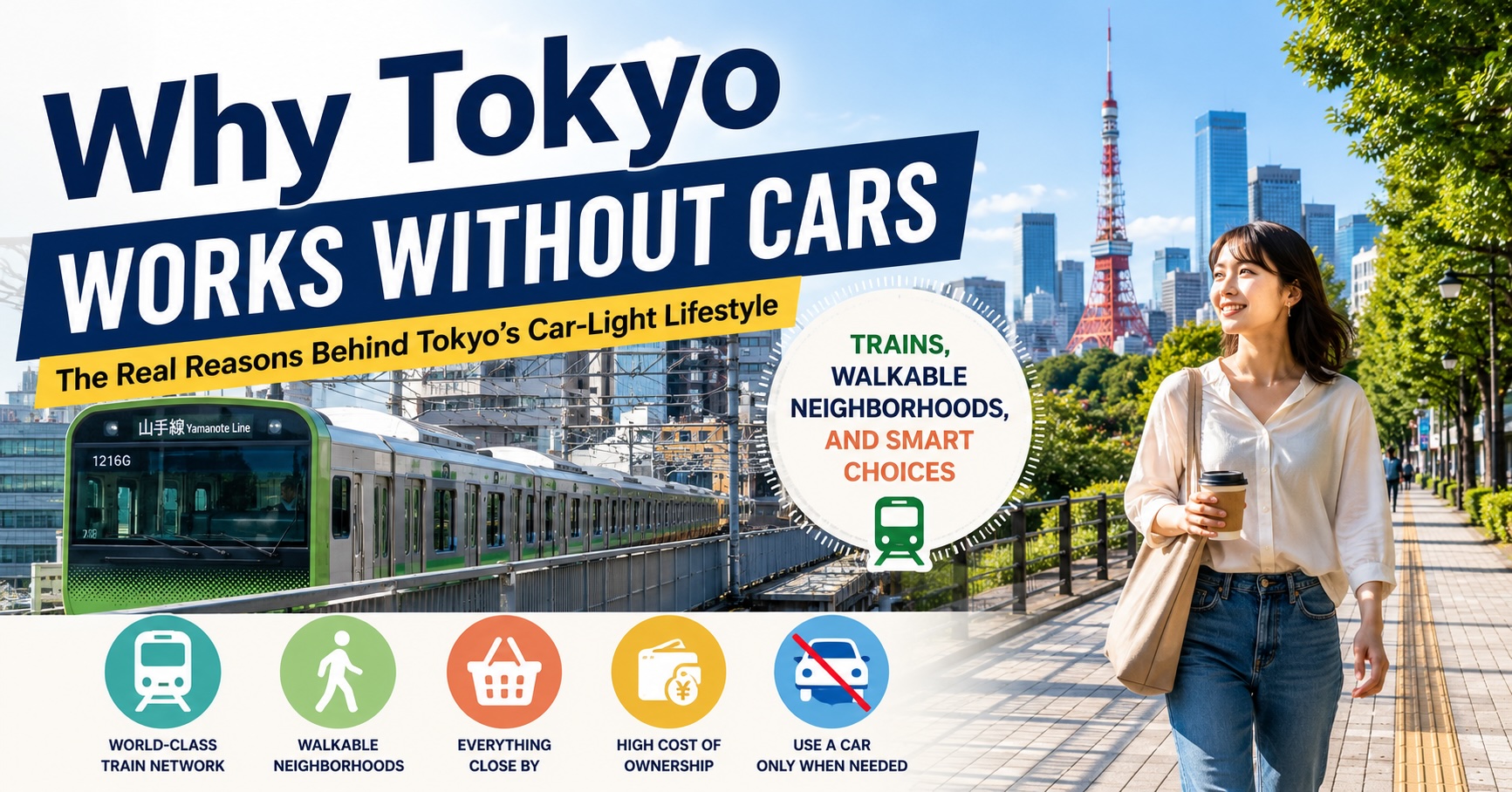
If you come from the United States, Canada, or Australia, Tokyo can feel almost unbelievable at first.
Despite being one of the largest metropolitan areas in the world, many residents live comfortably without owning a car.
- People commute by train every day
- Families often live without driving regularly
- Parking is limited and expensive
- Many neighborhoods are highly walkable
- Daily life functions efficiently without heavy car dependency
For many foreigners, this raises a simple question:
👉 How can a city this massive work without cars?
The answer is not that Tokyo banned cars.
Instead, Tokyo developed around rail transportation, compact neighborhoods, and local accessibility long before modern car-centered suburban development became dominant.
Tokyo Was Built Around Train Stations
One of the biggest differences between Tokyo and many Western cities is this:
👉 Tokyo developed around public transportation rather than highways.
After World War II, Tokyo expanded rapidly through railway-centered urban development.
Private railway companies helped develop entire residential areas around train lines and stations. As a result:
- Apartment buildings concentrated near stations
- Shops and restaurants developed locally
- Daily services became walkable
- Commuting by train became normal
This created a city structure where millions of people could access work, shopping, and entertainment without driving daily.
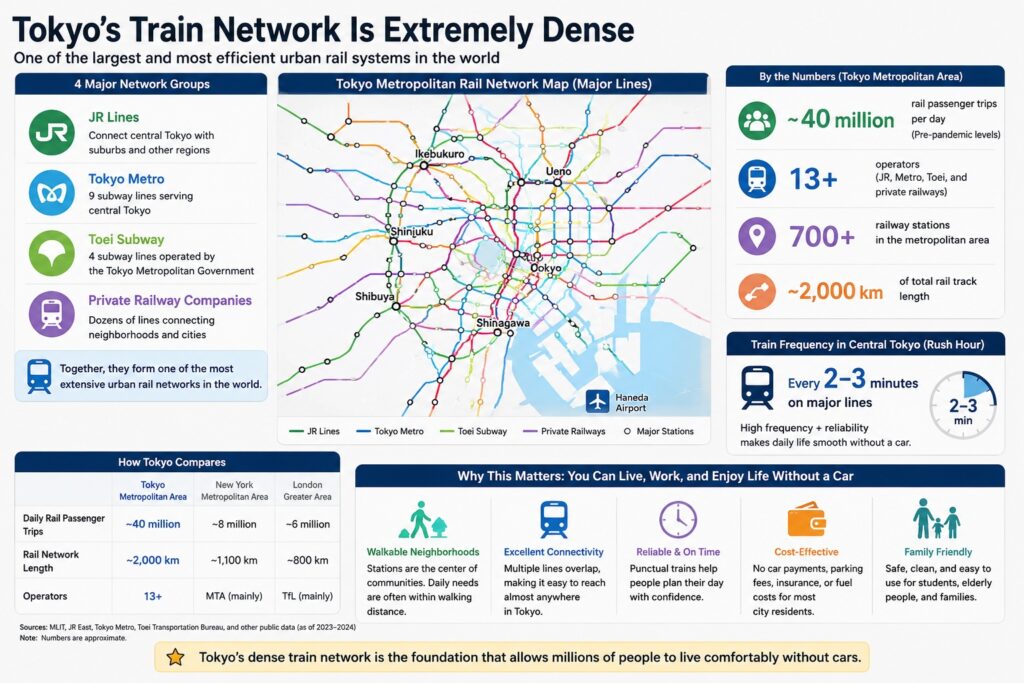
Tokyo’s Train Network Is Extremely Dense
Tokyo has one of the largest urban rail networks in the world.
According to transportation statistics, the Tokyo metropolitan area handles tens of millions of rail passenger trips per day across:
- JR lines
- Tokyo Metro
- Toei Subway
- Private railway companies
Train frequency is also extremely high.
In central Tokyo, trains during rush hour may arrive every 2–3 minutes on major lines.
This reliability changes daily behavior significantly.
People can structure life around public transportation with confidence.
For many Tokyo residents:
- Commuting
- Shopping
- School
- Entertainment
- Medical visits
can all be done without driving.
Owning a Car in Tokyo Is Expensive
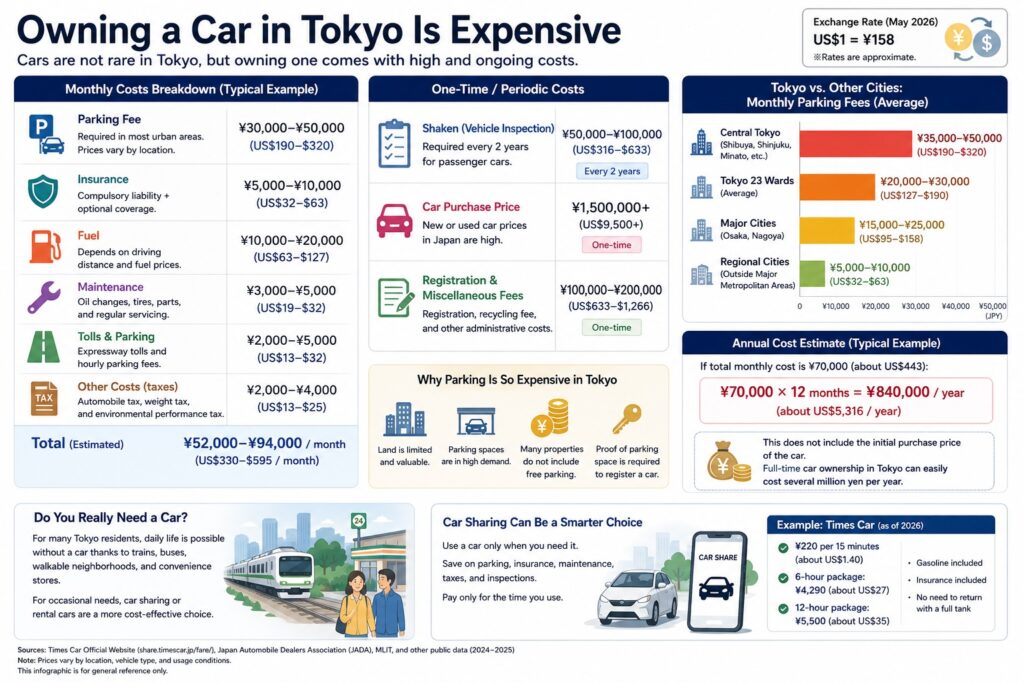
Cars are not rare in Tokyo.
However, ownership costs can become surprisingly high.
Typical expenses include:
- Parking fees
- Fuel
- Insurance
- Vehicle inspections (Shaken)
- Tolls
- Maintenance
- Vehicle taxes
Parking is especially important.
In many central Tokyo neighborhoods, monthly parking fees can exceed ¥30,000–¥50,000 per month (roughly US$190–US$320).
For this article, approximate currency conversions are based on:
👉 US$1 = approximately ¥158
Japan also requires proof of parking space ownership in many urban areas before registering a vehicle.
As a result, many residents eventually ask:
👉 “Do I really need a car?”
For a large percentage of Tokyo residents, the answer becomes:
👉 Not really.
Compact Neighborhoods Reduce Car Dependency
Tokyo’s urban structure also plays a major role.
Compared to many suburban areas in the United States:
- Stores are closer together
- Mixed-use neighborhoods are common
- Train stations act as local centers
- Restaurants and convenience stores are nearby
This reduces the need for long-distance driving.
In many Western cities, people often drive for:
- Groceries
- ATM access
- Restaurants
- Pharmacies
- Basic errands
But in Tokyo, many of these services exist within walking distance.
Convenience Stores Change Daily Life
One overlooked reason Tokyo works without cars is Japan’s convenience store network.
Convenience stores in Japan are not just small snack shops.
They often provide:
- ATM services
- Bill payment services
- Prepared meals
- Package pickup
- Basic groceries
- Household products
Because convenience stores are extremely common in urban Japan, many residents can complete small daily tasks without driving.
This supports a more localized lifestyle.
There Are Still Times When Cars Are Useful
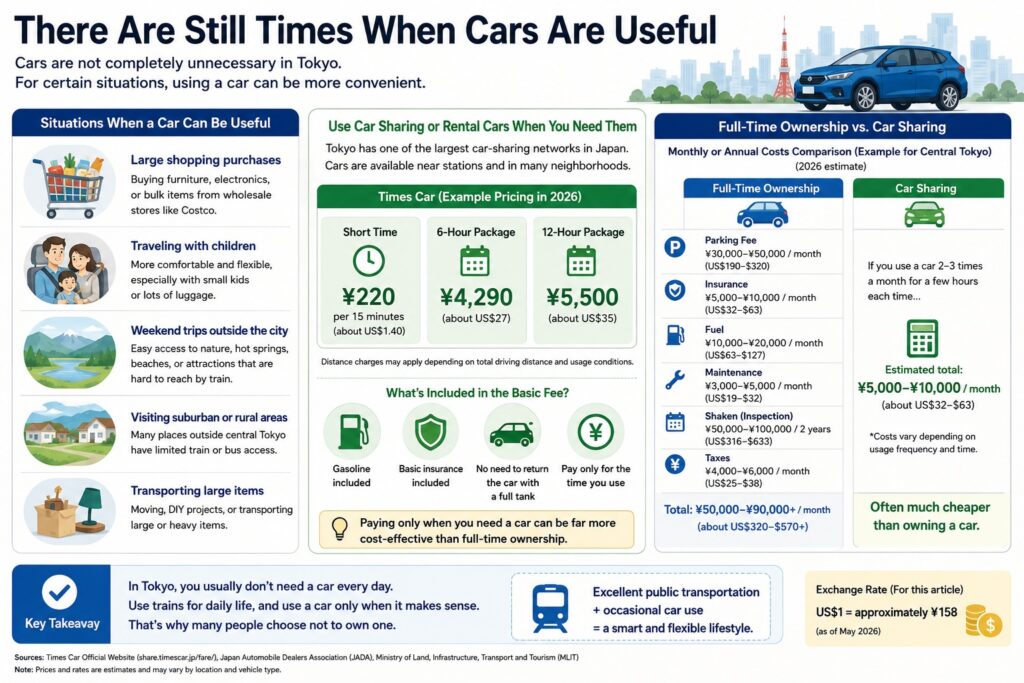
Of course, cars are not completely unnecessary in Tokyo.
There are situations where having access to a car can still feel convenient.
For example:
- large shopping purchases
- traveling with children
- weekend trips outside the city
- visiting suburban or rural areas
- transporting large household items
In these situations, many residents use:
- car sharing services
- rental cars
- short-term vehicle rentals
instead of owning a private vehicle full-time.
Tokyo has one of the largest car-sharing markets in Japan.
Services such as Times Car are widely available near train stations and residential neighborhoods.
As of 2026, standard Times Car rates start at approximately:
- ¥220 per 15 minutes (about US$1.40)
- 6-hour package: around ¥4,290 (about US$27)
- 12-hour package: around ¥5,500 (about US$35)
Gasoline costs and basic insurance are typically included in the usage fee, and users do not need to return the vehicle with a full tank.
Distance charges may still apply depending on total driving distance and usage conditions.
For people who only need a car occasionally, this can often be far more cost-effective than paying:
- monthly parking fees
- insurance
- maintenance costs
- vehicle taxes
- inspection costs
throughout the year.
Because many Tokyo residents rarely need to drive daily, the cost of full-time ownership often feels difficult to justify compared to occasional car-sharing use.
This is another reason many Tokyo residents choose not to own cars despite living in one of the world’s largest cities.
Smaller Homes Also Influence Transportation
Tokyo’s housing structure is closely connected to transportation behavior.
Because urban land is expensive and limited:
- Homes are often smaller
- Large garages are uncommon
- Driveways are limited
- Parking space is expensive
This encourages more compact urban development.
Rather than expanding outward through large car-centered suburbs, many Tokyo neighborhoods evolved around rail access and walkability.
This is one reason Tokyo often feels very different from car-oriented cities abroad.
Tokyo Is Not Completely Car-Free
Of course, Tokyo is not a perfect “car-free city.”
There are trade-offs.
- Rush hour trains can become extremely crowded
- Some outer suburban families still prefer cars
- Regional Japan remains far more car-dependent
- Smaller homes can feel restrictive
Car ownership is also more common outside central Tokyo.
So this transportation model mainly reflects life in dense urban areas.
Why Foreigners Often Find Tokyo Surprising
Many foreigners expect giant cities to require:
- Massive highways
- Large parking lots
- Daily driving
- Long suburban commutes
Tokyo developed differently.
The city became structured around:
- rail infrastructure
- high-density neighborhoods
- walkability
- compact living
- local accessibility
As a result, millions of people can live normal daily lives without depending heavily on cars.
That is one reason many visitors describe Tokyo as:
- efficient
- convenient
- walkable
- surprisingly livable
even without owning a car.
Related Articles
- Why Small Homes Actually Work in Japan
- Why Japanese Apartments Feel So Small (2026 Reality)
- Why Living in Japan Feels Cheap — But It’s Not That Simple
- The Reality of Saving Money in Japan in 2026
- Why Japanese Restaurants Are Surprisingly Cheap (2026 Reality)
- Transport in Japan Is Expensive? (2026 Cost Breakdown)
- Tokyo Apartment Rent (2026): Average Cost by Area