
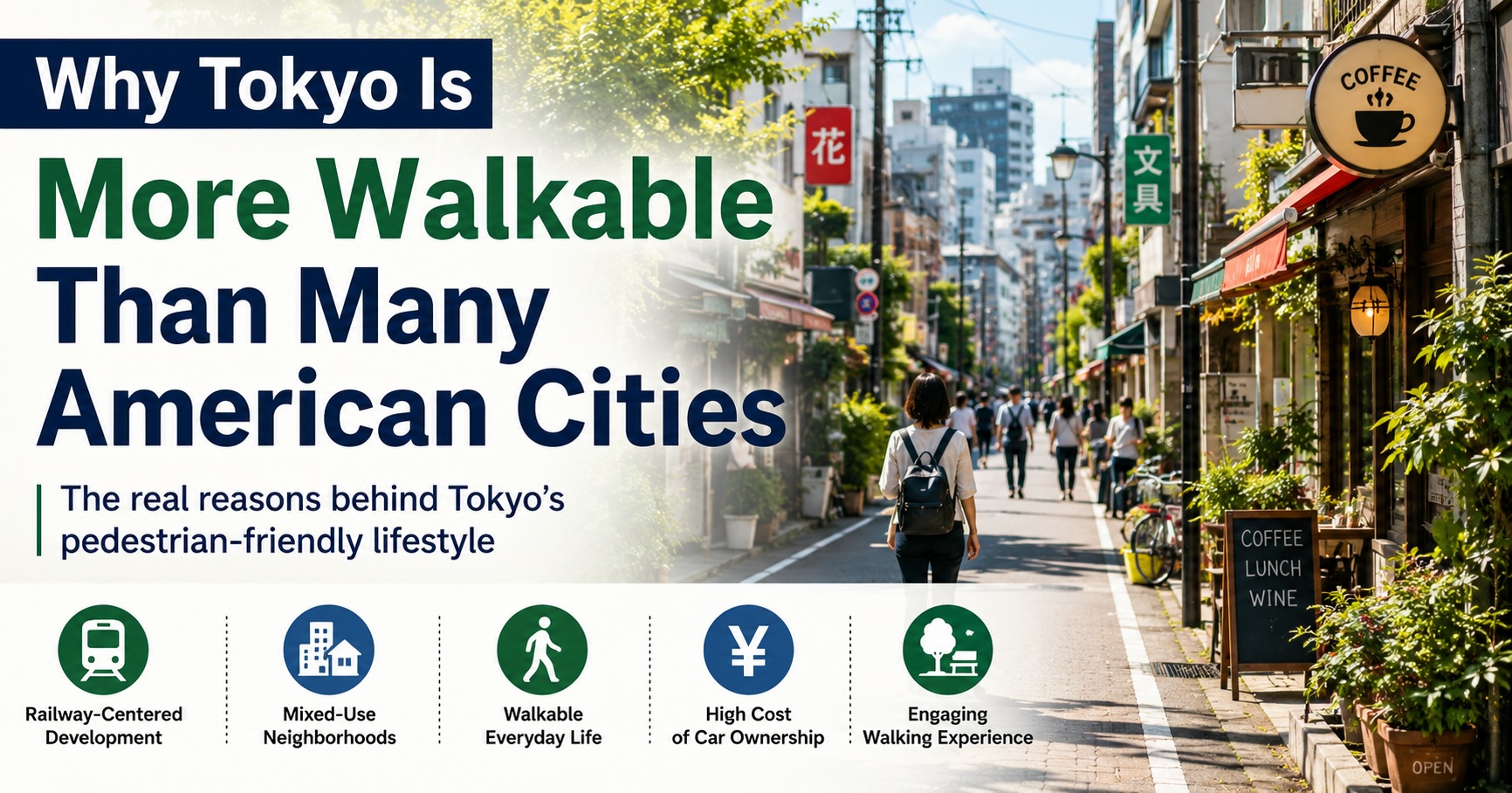
If you visit Tokyo for the first time, one thing often becomes immediately noticeable:
👉 Many parts of the city are surprisingly walkable.
In many neighborhoods, residents can handle most daily errands on foot:
- Convenience stores
- Supermarkets
- Restaurants
- Clinics
- Pharmacies
- Train stations
- Cafes
For many visitors from the United States, this can feel very different from daily life back home.
In many American cities, driving is often necessary for even short errands. Tokyo, on the other hand, was largely developed around public transportation and compact neighborhoods.
But this did not happen simply because people in Japan prefer walking.
Tokyo’s walkability is closely tied to transportation systems, land constraints, zoning rules, and economic realities.
Tokyo Developed Around Railways Instead of Highways
One of the biggest differences between Tokyo and many American cities is how the city expanded.
After World War II, many American metropolitan areas grew outward through highway expansion and suburban development.
Tokyo developed differently.
Private railway companies played a major role in expanding residential areas around train lines and stations. Over time, neighborhoods formed around rail hubs rather than large parking lots or freeway systems.
Today, train stations often function as the center of daily life in Tokyo neighborhoods.
As a result:
- Apartments concentrate near stations
- Retail businesses cluster around rail hubs
- Many residents can commute without driving
- Daily necessities remain within walking distance
Tokyo’s urban structure was heavily influenced by rail-oriented development rather than car-oriented suburban expansion.
Mixed-Use Neighborhoods Make Walking Practical
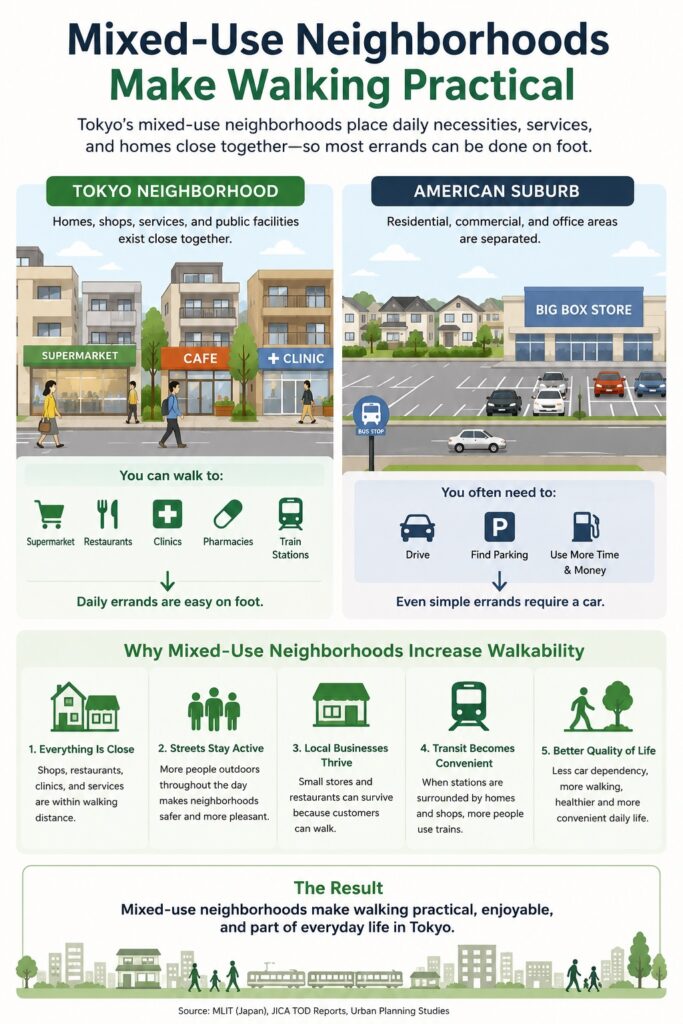
Another important factor is zoning.
In many American suburbs, residential and commercial areas are separated.
For example:
- Large supermarkets may require driving
- Restaurants are concentrated in commercial zones
- Offices and homes are often far apart
Tokyo functions differently.
Japanese zoning systems generally allow a wider mix of residential and commercial activity within the same neighborhood compared to many American suburban areas.
This creates communities where:
- Small restaurants operate near homes
- Convenience stores remain nearby
- Clinics and pharmacies are easily accessible
- Residents can complete errands without long drives
This mixed-use structure naturally increases walkability.
Narrow Streets Change the Walking Experience
Tokyo also has many narrow residential streets.
In many neighborhoods:
- Cars move slowly
- Heavy traffic is limited
- Pedestrians share space more naturally
- Large parking infrastructure is uncommon
This creates a calmer atmosphere for walking compared to many car-centered urban environments.
In contrast, many American cities were designed around larger roads, wider intersections, and large parking areas.
Even relatively short trips may involve:
- Large parking lots
- Multi-lane roads
- Long crossing distances
- Car-focused commercial areas
Tokyo’s smaller-scale street design changes how people experience daily life on foot.
Walking in Tokyo Often Feels More Engaging
Another interesting difference is the walking experience itself.
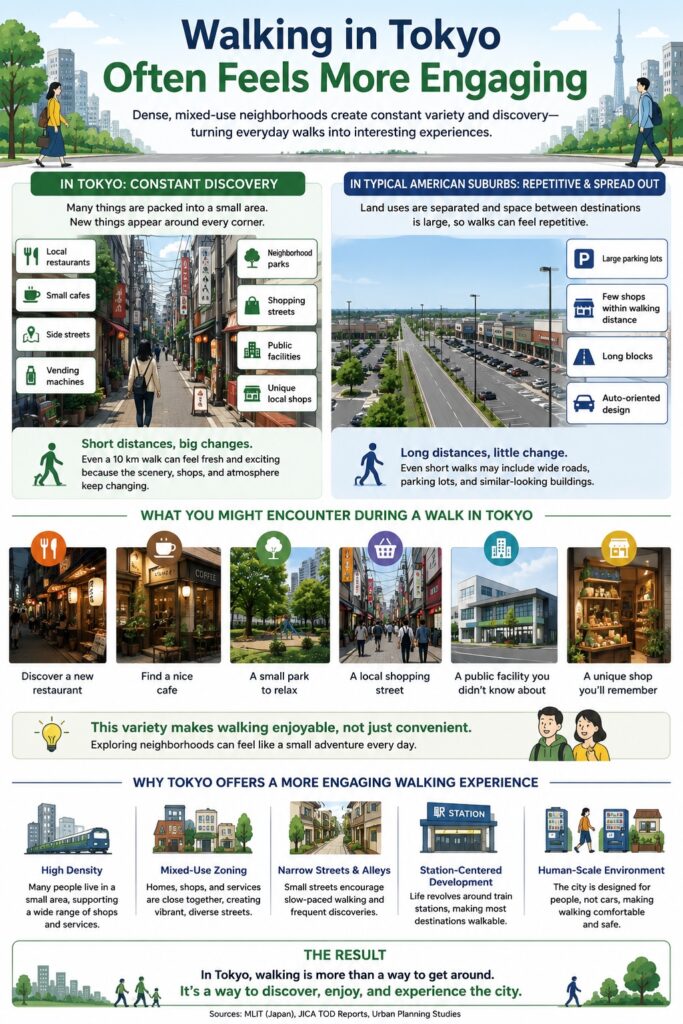
In many parts of Tokyo, neighborhoods can change noticeably within relatively short walking distances.
While walking through the city, people may encounter:
- Small local restaurants
- Independent cafes
- Tiny side streets
- Neighborhood parks
- Local shopping streets
- Unexpected public facilities
- Small specialty stores
Because shops, housing, and public services are densely packed together, walking often feels visually dynamic rather than repetitive.
In many car-centered suburban environments, long walks may involve large parking lots, wide roads, and repetitive commercial layouts.
Tokyo’s dense urban structure creates a very different experience.
For people who enjoy walking, exploring Tokyo neighborhoods can sometimes feel entertaining rather than inconvenient.
Many residents and visitors may find themselves walking much longer distances than expected simply because the environment constantly changes from block to block.
Owning a Car in Tokyo Is Expensive
Economic pressure also plays a major role.
Owning a car in Tokyo can be expensive due to:
- Parking costs
- Vehicle inspections (shaken)
- Fuel costs
- Insurance
- Tolls
- Limited parking availability
In many parts of Tokyo, monthly parking fees alone can cost tens of thousands of yen.
Japan also requires proof of parking ownership in many urban areas before registering a vehicle.
As a result, many residents choose not to own cars at all.
This further reinforces Tokyo’s pedestrian-oriented and train-centered urban structure.
High Population Density Supports Local Businesses
Tokyo’s density is another important factor.
Because large numbers of people live close together:
- Convenience stores remain profitable
- Local restaurants survive on foot traffic
- Train systems operate efficiently
- Neighborhood services stay nearby
In lower-density suburban environments, businesses often rely heavily on large parking lots and automobile access.
Tokyo’s density allows neighborhoods to function differently.
Walkability Comes With Trade-Offs
Tokyo’s walkability also comes with compromises.
For example:
- Apartments are often smaller
- Rush hour trains can become extremely crowded
- Personal living space is more limited
- Population density can feel intense
Tokyo did not become highly walkable simply because people preferred compact living.
In many ways, the city adapted to limited land availability, high population density, and transportation efficiency.
Final Thoughts
Tokyo feels more walkable than many American cities because it developed around railways, compact neighborhoods, and mixed-use urban planning rather than large-scale car infrastructure.
Over time, this created a city where many residents can live comfortably without depending heavily on cars.
For many visitors, Tokyo may feel unusually convenient and pedestrian-friendly.
But much of that convenience comes from decades of urban development shaped by transportation systems, land constraints, population density, and economic realities rather than simple cultural preference.