
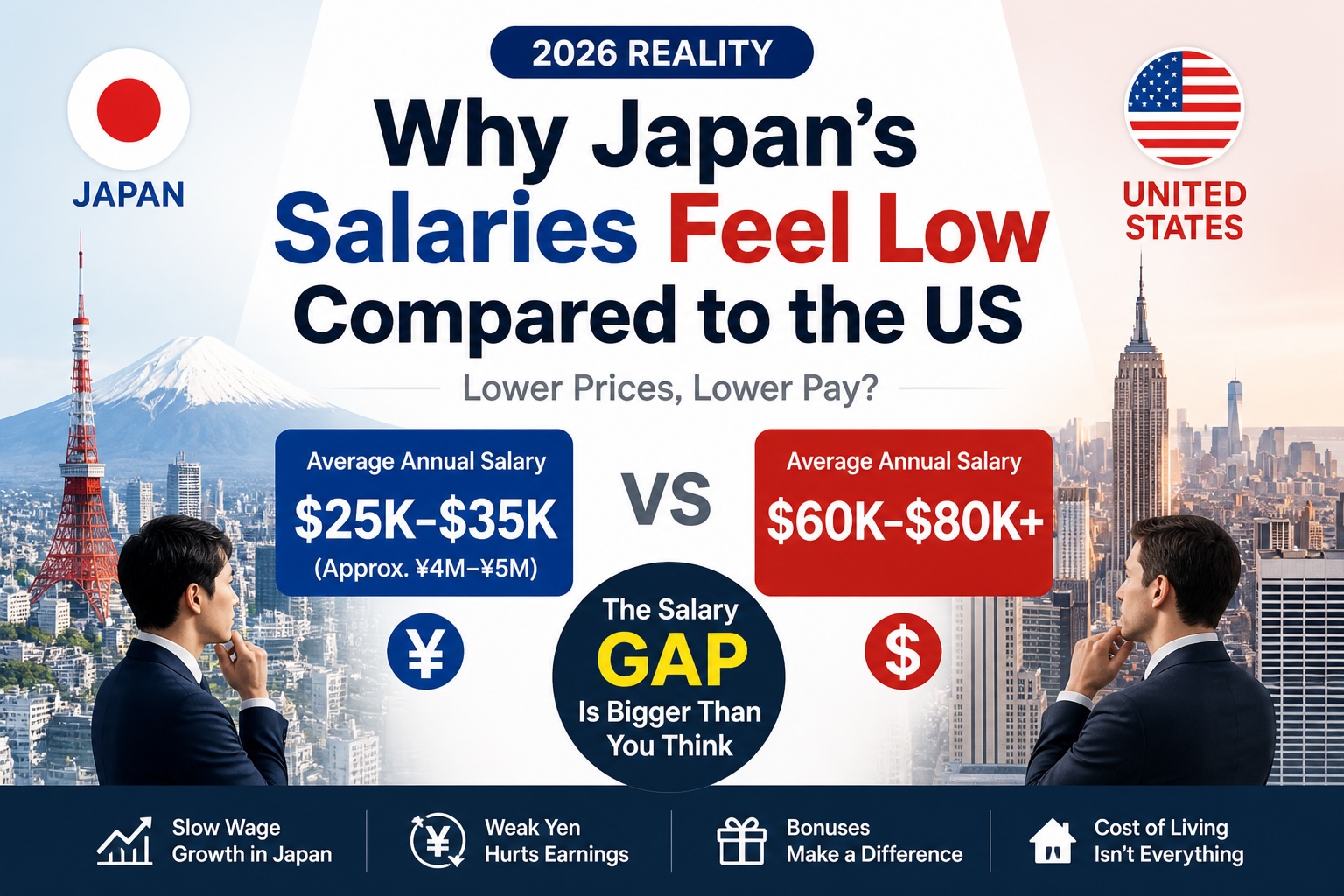
Many foreigners are surprised when they first look at salaries in Japan.
At first glance, Japan can feel affordable:
- Rent is often cheaper than major U.S. cities
- Public transportation is relatively inexpensive
- Healthcare costs are lower
- Eating out can be surprisingly affordable
But after looking at actual income levels, many people realize something important:
👉 Salaries in Japan are also much lower than in the United States.
This gap is one of the biggest misunderstandings people have about living in Japan.
In this article, we’ll explain:
- Why Japanese salaries feel low
- How Japan compares to the U.S.
- Why “cheap prices” do not always mean a higher standard of living
- The economic background behind Japan’s wage situation
Average Salaries: Japan vs the United States
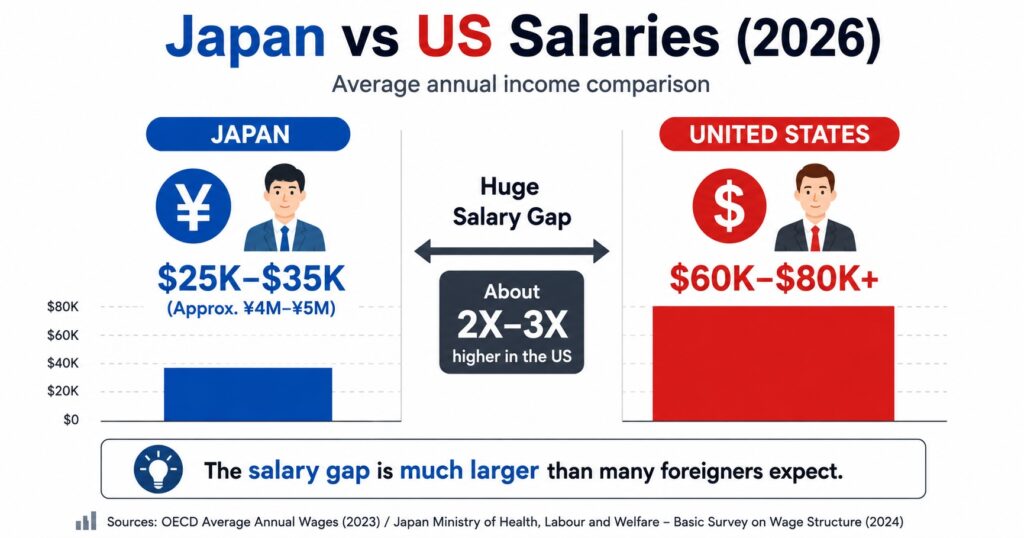
According to OECD wage statistics and Japan’s Ministry of Health, Labour and Welfare data, average wage levels in Japan remain significantly lower than those in the United States.
Approximate annual salary comparison (2026 exchange-rate adjusted estimate):
| Country | Approximate Average Annual Salary |
|---|---|
| United States | $60,000–$80,000+ |
| Japan | Roughly $25,000–$35,000 |
This does not mean every American earns a high salary or every Japanese worker earns less.
However, overall income levels in Japan are clearly lower compared to the U.S.
Because of the weak yen, Japanese salaries often look especially low when converted into U.S. dollars.
Related article:
Average Salary in Japan 2026: Real Monthly Pay & Take-Home Income
Japan Feels Cheap Because the Yen Is Weak
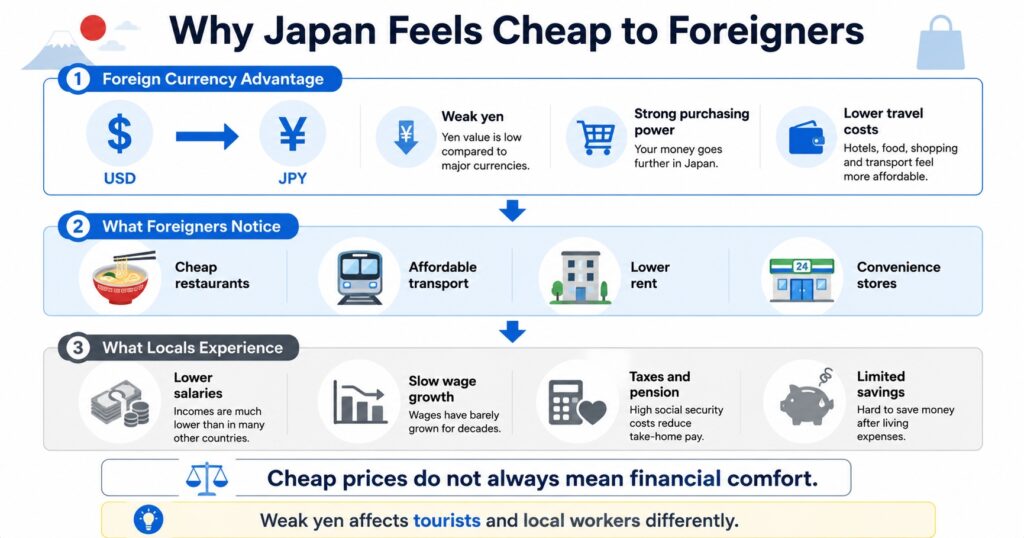
One major reason Japan feels inexpensive to foreigners is the exchange rate.
When the yen weakens:
- Foreign currencies gain purchasing power in Japan
- Hotels feel cheaper
- Restaurants feel cheaper
- Transportation feels cheaper
For tourists, this can make Japan feel like a bargain.
But Japanese workers are paid in yen.
That means:
👉 Lower prices do not automatically mean higher financial comfort for local residents.
A worker earning ¥300,000 per month may still struggle to save money after:
- Rent
- Taxes
- Pension contributions
- Insurance payments
- Food and utility costs
This is why many Japanese workers feel financially pressured despite relatively stable living costs.
Salary Growth in Japan Has Been Slow for Decades
One of the biggest structural issues is wage stagnation.
Japan experienced decades of relatively weak salary growth compared to the United States.
In the U.S.:
- Tech salaries expanded rapidly
- Finance wages increased significantly
- Asset prices rose strongly
- Labor mobility remained relatively high
In Japan:
- Companies focused heavily on cost control
- Lifetime employment culture slowed wage competition
- Salary growth remained modest
- Many workers stayed in lower-paying positions for long periods
According to OECD real wage growth data, Japan has experienced one of the weakest wage growth trends among major developed economies over the past several decades.
Bonuses Matter More in Japan
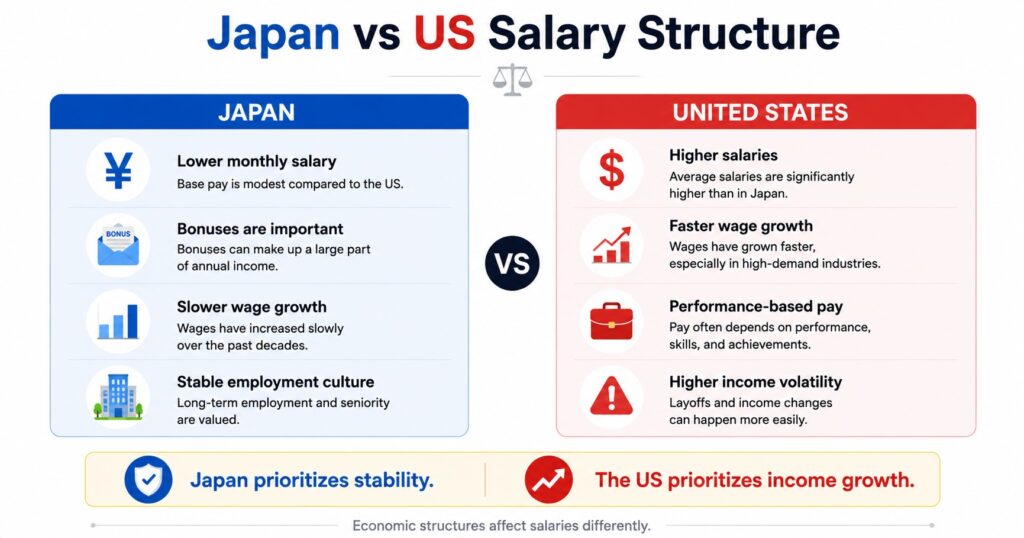
Another important difference is Japan’s compensation structure.
In many Japanese companies:
- Monthly salary is relatively modest
- Bonuses can make up a large portion of annual income
Many workers receive:
- Summer bonus
- Winter bonus
In some industries, bonuses may equal several months of salary.
This means monthly income alone can underestimate total annual compensation.
However:
👉 Bonuses are not always guaranteed.
Economic conditions and company performance can significantly affect bonus payments.
Related article:
Why Bonuses Matter More Than Salary in Japan (2026 Reality)
Tokyo Is Expensive Relative to Japanese Salaries
Many foreigners compare Tokyo to cities like:
- New York
- San Francisco
- Los Angeles
And conclude that Tokyo feels cheaper.
But this comparison often ignores local salary levels.
Tokyo salaries are also significantly lower than those in major U.S. cities.
So for many local workers:
👉 Housing costs can still feel expensive relative to income.
This is especially true for:
- Younger workers
- Single-income households
- Workers in lower-paying industries
Related articles:
Why This Creates Confusion Online
Online discussions about Japan often become confusing because people compare completely different perspectives.
Tourists may say:
“Japan is so cheap!”
Meanwhile local residents may feel:
“Salaries are too low.”
Both perspectives can be true at the same time.
Japan can feel affordable to people earning foreign salaries while still feeling financially restrictive for many domestic workers.
Final Thoughts
Japan’s lower salary levels are influenced by multiple long-term factors:
- Slow wage growth
- Weak yen
- Conservative corporate culture
- Bonus-heavy compensation structures
- Historically low inflation
At the same time, Japan also offers:
- Safety
- Stable infrastructure
- Affordable healthcare
- Reliable public transportation
This is why Japan often feels inexpensive to visitors while many local workers still feel financial pressure.
Understanding both sides is important when comparing Japan to the United States.
Sources
- OECD Average Annual Wages Statistics
- Japan Ministry of Health, Labour and Welfare Wage Survey
- Statistics Bureau of Japan