
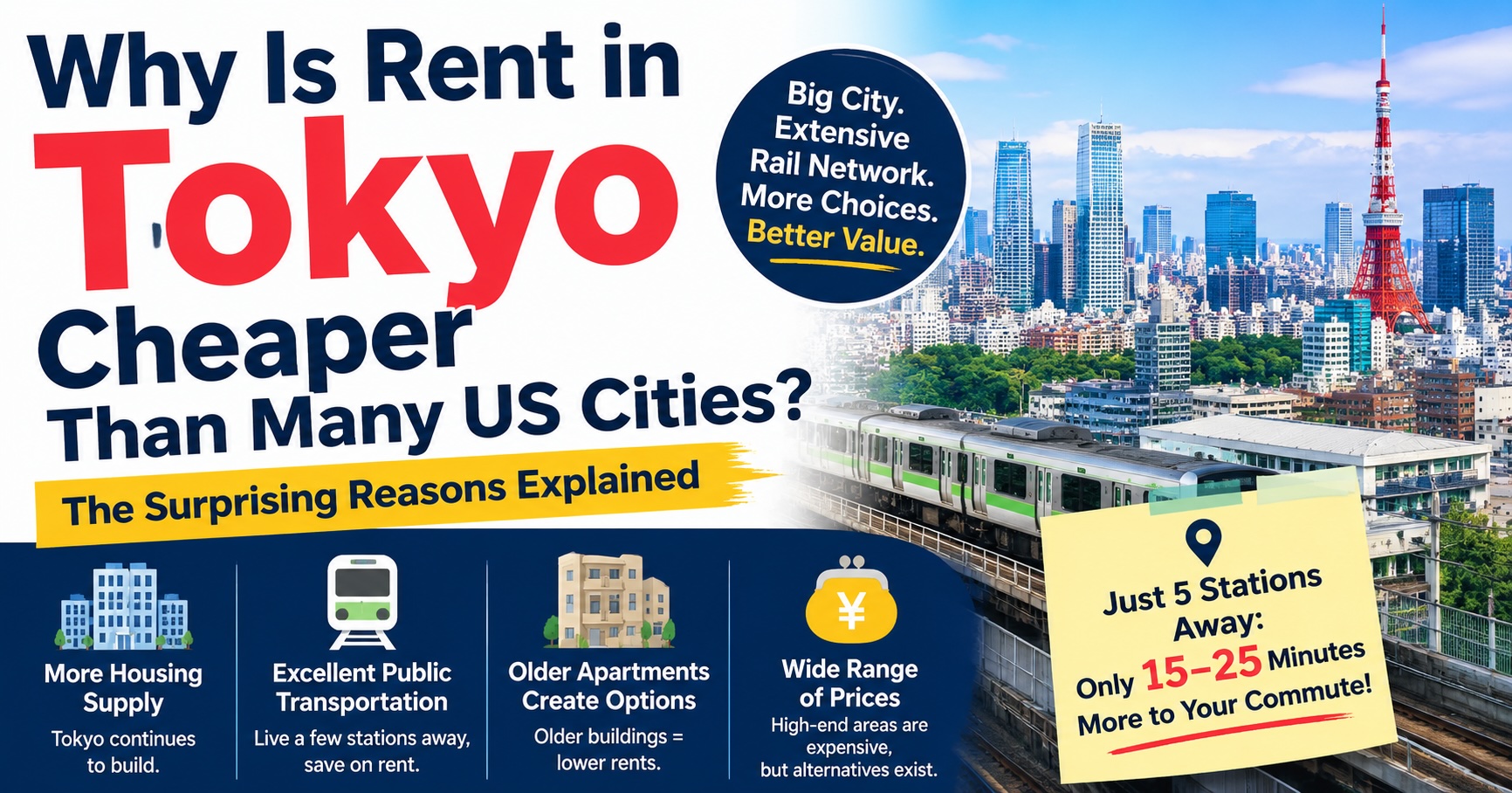
Many Americans assume Tokyo must be one of the most expensive cities in the world.
After all, Tokyo is the largest metropolitan area on Earth, home to millions of residents, crowded train stations, and some of the world’s busiest business districts.
Yet when people start comparing rents, they often discover something surprising:
Rent in Tokyo is frequently lower than rent in major high-cost US cities such as New York, San Francisco, Boston, Seattle, and Los Angeles.
This can seem counterintuitive. How can one of the world’s largest cities offer relatively affordable housing?
The answer lies in how Tokyo builds housing, uses land efficiently, and connects neighborhoods through public transportation.
Tokyo Continues to Build Housing
One of the biggest differences between Tokyo and many American cities is housing supply.
Tokyo continues to add new apartments and residential buildings every year. Older buildings are often replaced by newer developments, allowing the housing stock to grow alongside demand.
In many US cities, housing construction can be slowed by zoning restrictions, lengthy approval processes, and local opposition to new development.
When supply struggles to keep up with demand, rents tend to rise.
Tokyo’s willingness to continue building housing has helped prevent the severe shortages seen in some American metropolitan areas.
If you would like to see actual rental prices across Japan, you may also find this article useful:
Average Rent in Japan (2026): Tokyo vs Other Cities
Higher Density Makes Housing More Efficient
Tokyo is built at a much higher density than many American cities.
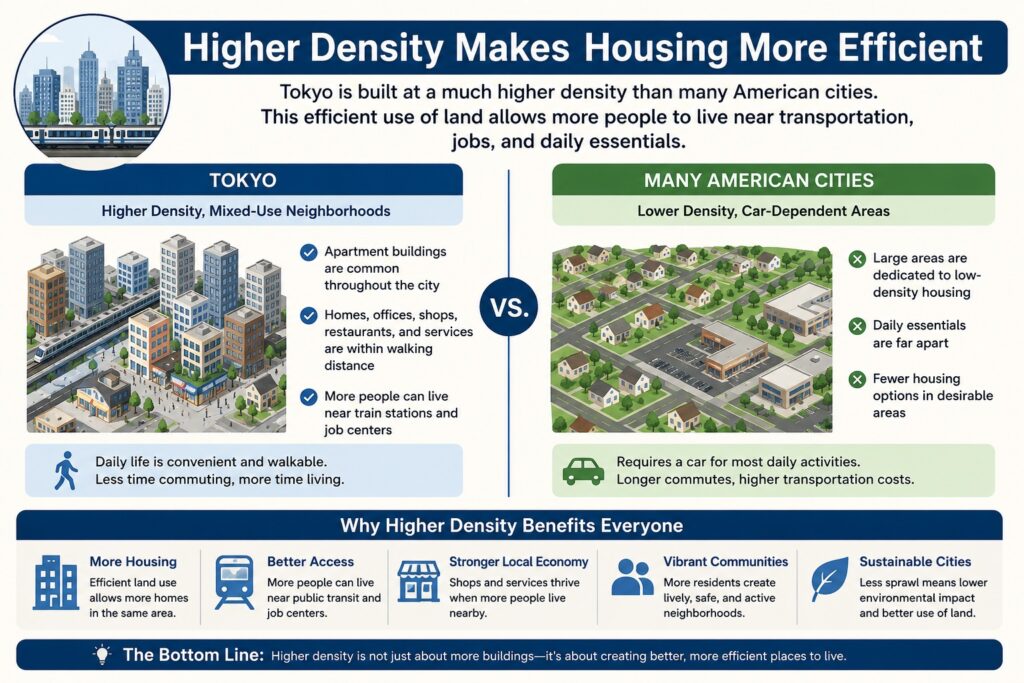
Apartment buildings are common throughout the metropolitan area, including neighborhoods close to train stations.
Many districts combine housing, restaurants, offices, convenience stores, clinics, supermarkets, and other daily necessities within walking distance.
This efficient use of land allows more people to live near transportation and employment centers.
In contrast, many American cities devote large amounts of land to low-density housing, which can limit the number of homes available in desirable areas.
This is one reason Tokyo remains highly walkable compared with many American cities.
Why Tokyo Is More Walkable Than Many American Cities
Public Transportation Expands Housing Options
Tokyo’s rail network is one of the largest and most heavily used transportation systems in the world.
Because trains are frequent and reliable, residents do not necessarily need to live directly in the city center.
Instead, many people choose neighborhoods several stations away from major business districts.
This spreads housing demand across a much larger area and helps reduce pressure on central neighborhoods.
Tokyo’s transportation system is also one reason many residents do not need to own a car.
For many residents, the ability to live farther from work without relying on a car creates significantly more housing choices.
Older Apartments Create Affordable Options
Another important factor is how housing is viewed in Japan.
Unlike in many countries where older homes may increase in value, Japanese residential buildings often lose value as they age.
As a result, older apartments frequently remain available at lower rental prices.
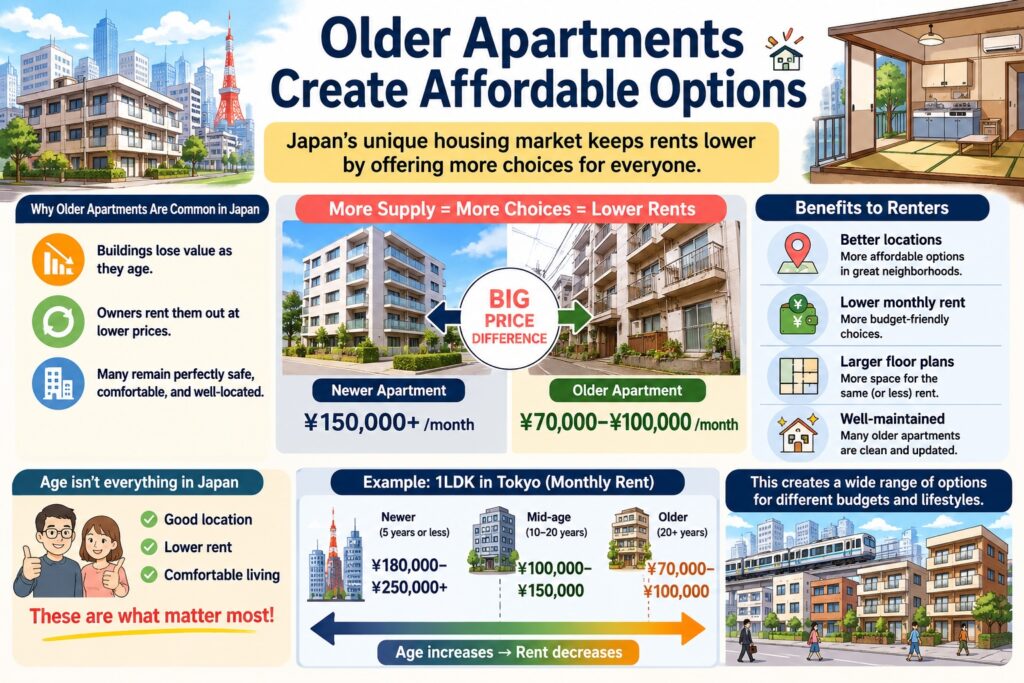
This creates a wider range of options for renters across different budgets.
Many residents are willing to trade a newer building for a better location or lower monthly rent.
If you’re curious why Japanese homes and apartments often look smaller than their Western counterparts, this article explains some of the reasons:
Why Japanese Apartments Feel So Small
Tokyo Is Not Cheap Everywhere
Of course, Tokyo is not a cheap city.
Premium districts such as Minato, Chiyoda, and parts of Shibuya can be extremely expensive.
For example, a typical 1LDK apartment in Minato Ward often rents for around ¥270,000–¥360,000 per month (approximately $1,800–$2,400 USD at an exchange rate of ¥150 = $1).
Luxury apartments in neighborhoods such as Roppongi, Azabu, and Akasaka can be even more expensive. In some high-end towers, monthly rents may exceed ¥500,000–¥1,000,000 ($3,300–$6,700 USD), particularly for larger units with concierge services, security staff, gyms, and premium locations.
However, what makes Tokyo different is that more affordable alternatives often remain available nearby.
Even within the same ward, rental prices can vary dramatically depending on building age, proximity to train stations, and neighborhood popularity.
For example, moving just a few stations away from central districts can often reduce monthly rent substantially while keeping commuting times relatively manageable.
Personal Observation
After living in Japan for decades, one thing I have consistently noticed is how quickly rental prices change within Tokyo.
A move of just a few train stations can make a surprisingly large difference in monthly rent. Apartments located three to five stops away from major business districts are often noticeably cheaper, while commuting times remain relatively reasonable thanks to Tokyo’s extensive rail network.
Another factor that surprises many visitors is how short the distance between stations can be. In many parts of Tokyo, traveling between neighboring stations takes only a few minutes. Even living five stations away from a major hub often adds only around 15–25 minutes to a commute, which is far less than many people expect.
Choosing an apartment that is a 10-minute walk from the station instead of right next to it can reduce costs even further, and larger floor plans often become available.
For many residents, this creates a practical trade-off between convenience, living space, and housing costs.
Why This Matters for Foreign Residents
Many foreigners arrive in Tokyo assuming they must live in central districts such as Shibuya, Shinjuku, or Minato.
In reality, some of the best value can often be found just outside these areas.
Thanks to Tokyo’s extensive rail network, neighborhoods located a few stations away can still offer convenient access to the city center while providing lower rents and larger apartments.
This flexibility is one of the reasons many long-term residents find Tokyo’s housing market more affordable than they initially expected.
Conclusion
Tokyo is certainly not a cheap city.
However, compared with many high-cost American cities, its housing market operates differently.
Continuous housing construction, higher-density development, extensive public transportation, and a large supply of older apartments all help keep rents lower than many people expect.
While luxury neighborhoods can be extremely expensive, affordable alternatives often remain available within a relatively short train ride.
For many visitors and newcomers, discovering how flexible Tokyo’s rental market can be is often one of the city’s biggest surprises.
If you’re interested in learning more about housing and living costs in Japan, you may also enjoy:
- Average Rent in Japan (2026): Tokyo vs Other Cities
- Why Tokyo Is More Walkable Than Many American Cities
- Why Tokyo Works Without Cars
- Why Japanese Apartments Feel So Small
- Why Small Homes Actually Work in Japan
Exchange rate used in this article: ¥150 = $1 USD (rounded for simplicity).