
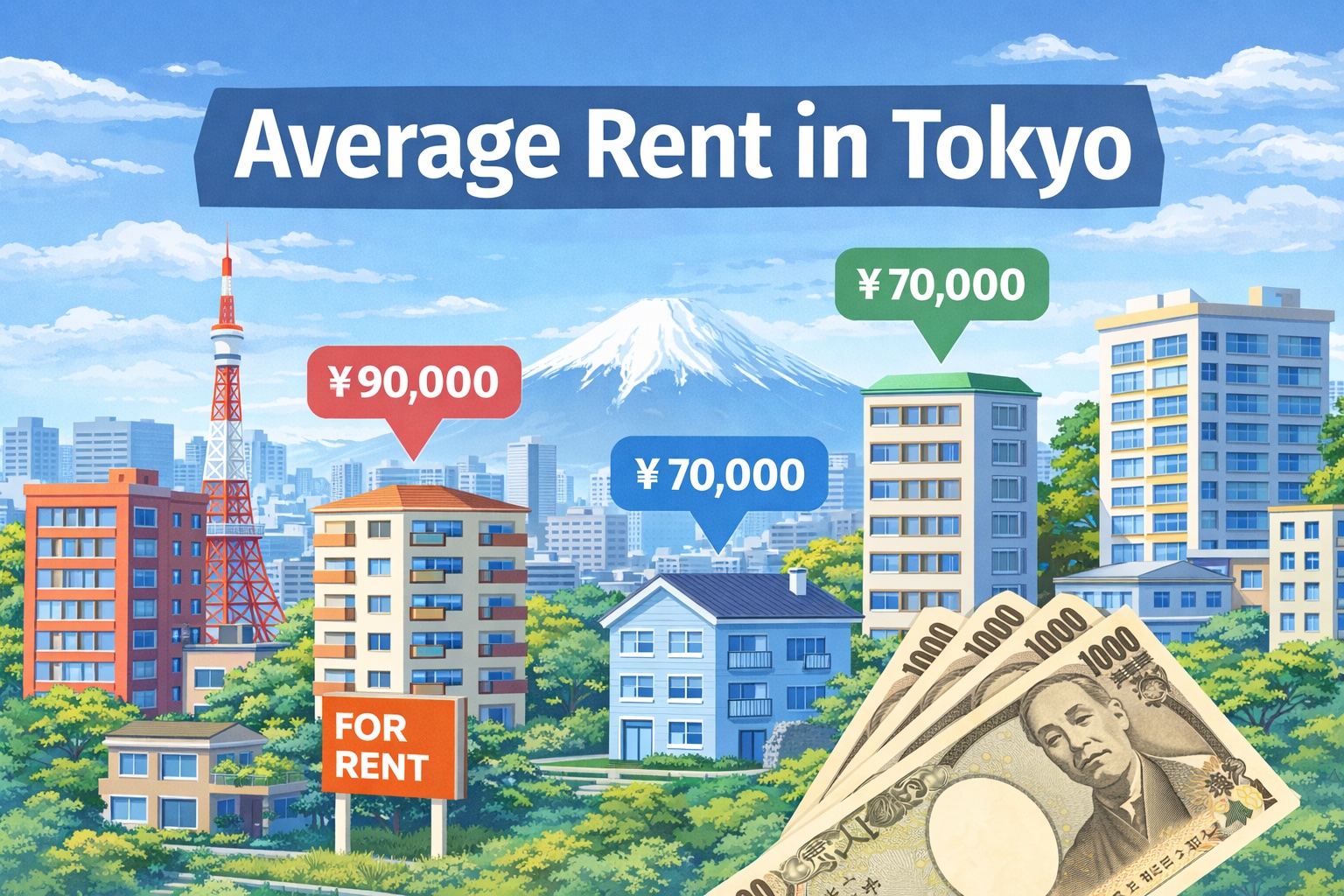
Many foreigners assume that Tokyo must be one of the most expensive cities in the world.
After all, Tokyo is Japan’s capital, one of the world’s largest metropolitan areas, and home to millions of people.
So when people begin researching apartments, they often expect rents similar to New York, London, or San Francisco.
Then they start browsing actual apartment listings.
And many have the same reaction.
“That’s cheaper than I expected.”
This doesn’t mean Tokyo is cheap.
Housing is still one of the largest expenses for most residents.
However, compared with many major global cities, Tokyo’s rental market is often more affordable than foreigners imagine.
The real challenge is understanding how much rent varies across the city.
Two apartments with the same size can have dramatically different prices depending on location, building age, and access to transportation.
In this guide, we’ll break down average apartment rent in Tokyo, compare different areas, examine what kind of apartment various budgets can rent, and explain some of the hidden costs that surprise many newcomers.
Exchange rate used throughout this article: ¥150 = $1 USD
How Much Is Rent in Tokyo?
The average rent in Tokyo depends heavily on location and apartment size.
For most single residents, small apartments such as 1R and 1K units are the most common choice.
For couples and families, 1LDK and 2LDK apartments are more common.
| Apartment Type | Typical Monthly Rent |
|---|---|
| 1R / 1K | ¥70,000–100,000 ($470–670) |
| 1LDK | ¥115,000–180,000 ($770–1,200) |
| 2LDK | ¥170,000–250,000 ($1,130–1,670) |
Family-sized apartments with three bedrooms or more can easily exceed ¥300,000 ($2,000) per month, particularly in central Tokyo.
These figures represent broad averages across Tokyo rather than specific neighborhoods.
A similar apartment may cost significantly more in central districts such as Minato or Shibuya than in outer wards such as Adachi or Edogawa.
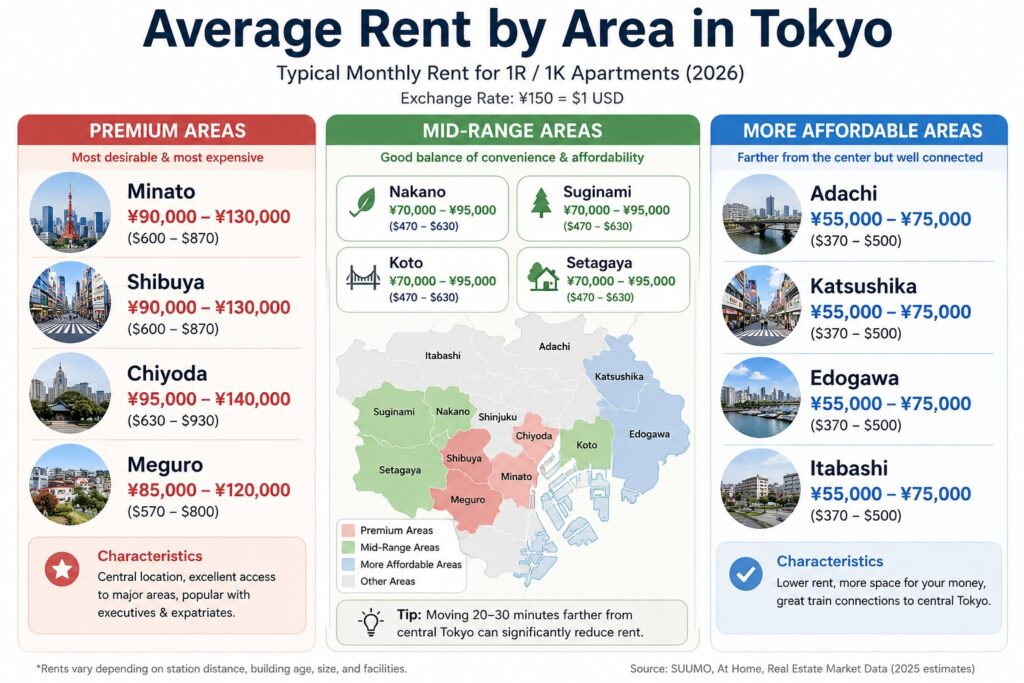
Average Rent by Area in Tokyo
Location is usually the single biggest factor affecting rent.
Even a difference of a few train stations can noticeably change monthly housing costs.
Premium Areas
These districts are among Tokyo’s most desirable and expensive places to live.
- Minato
- Shibuya
- Chiyoda
- Meguro
These neighborhoods are popular with executives, expatriates, and high-income households.
Typical small apartment rent: ¥90,000–130,000 ($600–870)
Large family apartments often exceed ¥300,000–500,000 ($2,000–3,330) per month.
Mid-Range Areas
- Nakano
- Suginami
- Koto
- Setagaya
These areas offer a balance between convenience and affordability.
They are popular among both Japanese residents and long-term foreign residents.
Typical small apartment rent: ¥70,000–95,000 ($470–630)
More Affordable Areas
- Adachi
- Katsushika
- Edogawa
- Itabashi
These wards are farther from central Tokyo but remain well connected by train.
Typical small apartment rent: ¥55,000–75,000 ($370–500)
For many residents, living 20–30 minutes farther from the city center can reduce rent dramatically without significantly affecting daily life.
Related article:
Average Rent in Japan (2026): Tokyo vs Other Cities
What Can Different Budgets Actually Rent?
This is often the question people care about most.
Average rent statistics are useful, but they don’t always help you visualize what kind of apartment you can actually rent.
Budget: ¥80,000 ($530)
At this price point, you can usually expect:
- A small 1R or 1K apartment
- 18–25㎡ (194–269 sq ft)
- An older building
- A location outside central Tokyo
This budget is common among students, language school attendees, and younger workers.
Budget: ¥120,000 ($800)
At this level, renters can often find:
- A newer 1K apartment or a modest 1LDK
- 20–35㎡ (215–377 sq ft)
- Good access to train stations
- Popular residential neighborhoods
Many office workers living alone fall into this range.
A budget of ¥120,000 ($800) may rent a comfortable apartment in areas such as Nakano or Suginami, while the same budget in Minato or Shibuya may only secure a smaller or older unit.
Budget: ¥200,000 ($1,330)
This budget typically allows:
- A spacious 1LDK or small 2LDK
- 40–60㎡ (430–646 sq ft)
- Newer buildings
- Better locations
This range is popular with couples and dual-income households.
Budget: ¥300,000+ ($2,000+)
At this level, renters can often access:
- Large family apartments
- Premium locations
- Luxury buildings
- 60–90㎡+ properties
Family-sized apartments in central Tokyo can easily exceed ¥300,000 ($2,000) per month, particularly in areas such as Minato, Shibuya, and Chiyoda.
Why Are Tokyo Apartments So Small?
Many foreigners are surprised by apartment size rather than rent.
In cities such as New York, Toronto, Sydney, or many parts of the United States, apartments are often much larger than their Tokyo equivalents.
Tokyo apartments are compact because land is expensive and urban space is limited.
Developers have spent decades designing apartments that maximize convenience while minimizing space.
As a result, many residents prioritize location over square footage.
| Apartment Type | Typical Size |
|---|---|
| 1R / 1K | 15–30㎡ (160–320 sq ft) |
| 1LDK | 30–45㎡ (320–485 sq ft) |
| 2LDK | 50–70㎡ (540–750 sq ft) |
| Family Apartment | 70㎡+ (750+ sq ft) |
Many first-time visitors assume these sizes would feel uncomfortable.
However, many Japanese apartments are designed surprisingly efficiently.
Built-in storage, compact bathrooms, and efficient layouts help make smaller spaces more practical than their size might suggest.
Related article:
Why Japanese Apartments Feel So Small (2026 Reality)
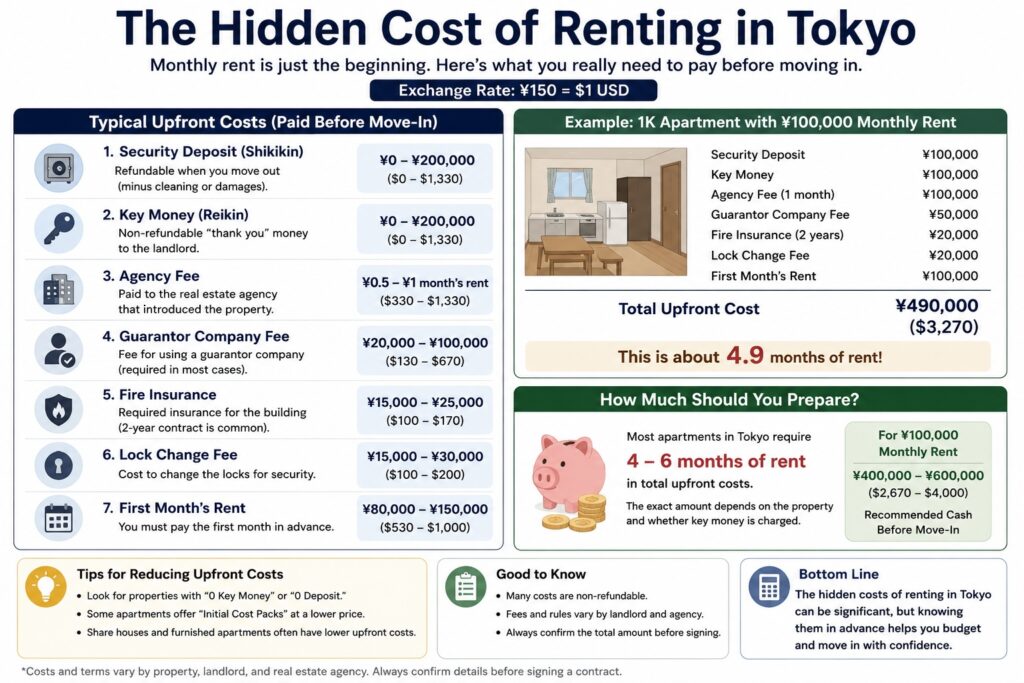
The Hidden Cost of Renting in Tokyo
Monthly rent is only part of the cost of renting an apartment in Japan.
Many foreigners are surprised by the upfront expenses required before moving in.
Typical move-in costs may include:
- Security deposit (Shikikin)
- Key money (Reikin)
- Agency fee
- Guarantor company fee
- Fire insurance
- Lock replacement fee
- First month’s rent
As a result, moving into an apartment often requires cash equal to four to six months of rent.
For example, a ¥100,000 apartment ($670 per month) may require approximately ¥450,000–600,000 ($3,000–4,000) before move-in.
This is one of the biggest surprises for newcomers to Japan.
Related articles:
- Hidden Costs of Renting an Apartment in Japan (2026): Fees You Must Know
- How to Rent an Apartment in Japan (2026 Guide): Costs, Process & Tips for Foreigners
Why Rent Varies So Much Across Tokyo
One of the most confusing aspects of apartment hunting in Tokyo is how dramatically rent can change across the city.
Two apartments with similar layouts may have very different prices.
Several factors influence rent:
- Distance from central Tokyo
- Walking time to the nearest station
- Building age
- Apartment size
- Access to major train lines
For example, a small apartment near Shibuya Station may cost nearly twice as much as a similar apartment in Adachi Ward.
Likewise, an apartment built within the last five years often commands a significant premium compared with a similar apartment built twenty or thirty years ago.
For budget-conscious renters, location is often the most important decision.
A slightly longer commute can result in substantial savings every month.
Related article:
Why Is Rent in Tokyo Cheaper Than Many US Cities?
Frequently Asked Questions
Is Tokyo rent expensive?
Compared with most cities in Japan, yes.
Tokyo generally has the highest rents in the country.
However, compared with major global cities such as New York, London, or San Francisco, Tokyo is often more affordable than many foreigners expect.
What is the cheapest area in Tokyo?
Areas such as Adachi, Katsushika, Edogawa, and Itabashi are generally among the more affordable wards within Tokyo’s 23 wards.
They are popular with residents who prioritize lower rent over living in the city center.
Can foreigners rent apartments in Tokyo?
Yes.
Millions of foreign residents live in Japan, and many successfully rent apartments every year.
However, some landlords have restrictions, which is why working with a foreigner-friendly real estate agency can make the process easier.
How much money should I prepare before moving?
A good rule of thumb is to have at least four to six months of rent available for initial expenses.
This covers deposits, fees, insurance, and the first month’s rent.
Is it cheaper to live outside central Tokyo?
Usually, yes.
Moving farther from major business districts often reduces rent significantly while still providing access to Tokyo’s extensive train network.
Final Thoughts
Tokyo’s rental market is often misunderstood.
Many people expect rents to be far higher simply because Tokyo is one of the world’s largest cities.
The reality is more nuanced.
Rent varies enormously depending on location, apartment size, building age, and transportation access.
For many foreigners, the biggest surprises are not the monthly rent itself, but the smaller apartment sizes and the substantial upfront move-in costs.
The good news is that Tokyo offers a wide range of housing options.
Whether your budget is ¥80,000 ($530) or ¥300,000+ ($2,000+) per month, there are neighborhoods and apartment types that can fit your needs.
The key is understanding how location affects rent and deciding what matters most to your lifestyle.