
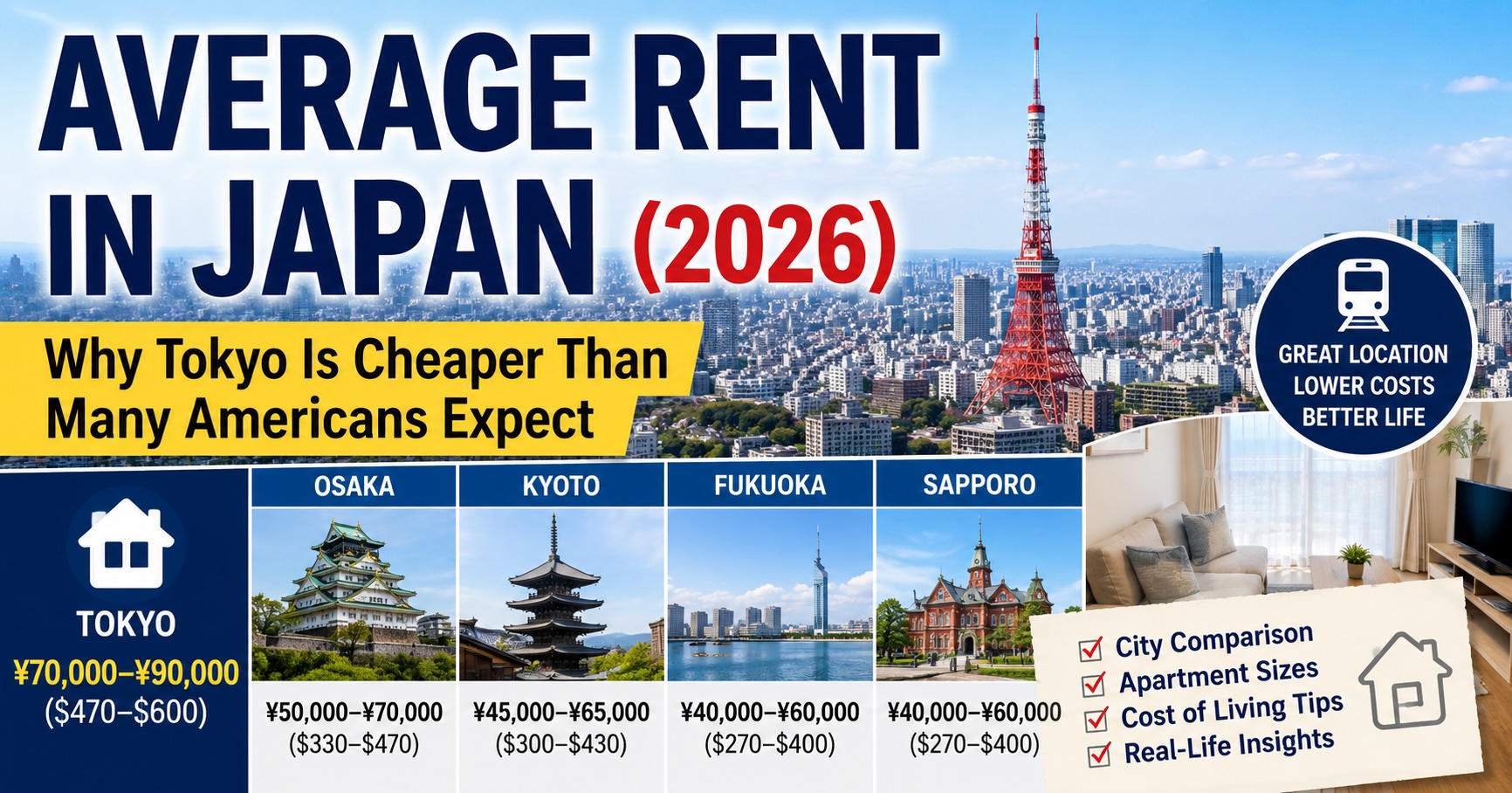
Many foreigners assume Tokyo must be one of the most expensive cities in the world.
After all, the Tokyo metropolitan area is home to roughly 37 million people, making it the largest metropolitan area on Earth.
Logically, rents should be sky-high.
Yet the reality often surprises people visiting Japan for the first time.
In many cases, renting an apartment in Tokyo costs less than renting in New York, San Francisco, Vancouver, Sydney, or London.
How is that possible?
The answer reveals something unique about Japan’s housing market.
Exchange rate used throughout this article: ¥150 = $1 USD
What Is the Average Rent in Japan?
Average rent varies significantly depending on the city, apartment size, and distance from the nearest train station.
For a typical single person living alone, monthly rents are often around:
| Apartment Type | Monthly Rent | USD Equivalent |
|---|---|---|
| 1K Apartment | ¥60,000–¥80,000 | $400–$530 |
| 1LDK Apartment | ¥90,000–¥130,000 | $600–$870 |
| 2LDK Apartment | ¥120,000–¥180,000 | $800–$1,200 |
For many foreigners, these numbers are lower than expected, especially when compared with major cities in North America and Western Europe.
Average Rent by City
Rent differs considerably across Japan.
Here are typical monthly rents for a single-person apartment near urban areas.
| City | Typical Monthly Rent | USD Equivalent |
|---|---|---|
| Tokyo | ¥70,000–¥90,000 | $470–$600 |
| Osaka | ¥50,000–¥70,000 | $330–$470 |
| Kyoto | ¥45,000–¥65,000 | $300–$430 |
| Fukuoka | ¥40,000–¥60,000 | $270–$400 |
| Sapporo | ¥40,000–¥60,000 | $270–$400 |
Tokyo remains the most expensive city in Japan.
However, compared with cities of similar global importance, many people find Tokyo surprisingly affordable.
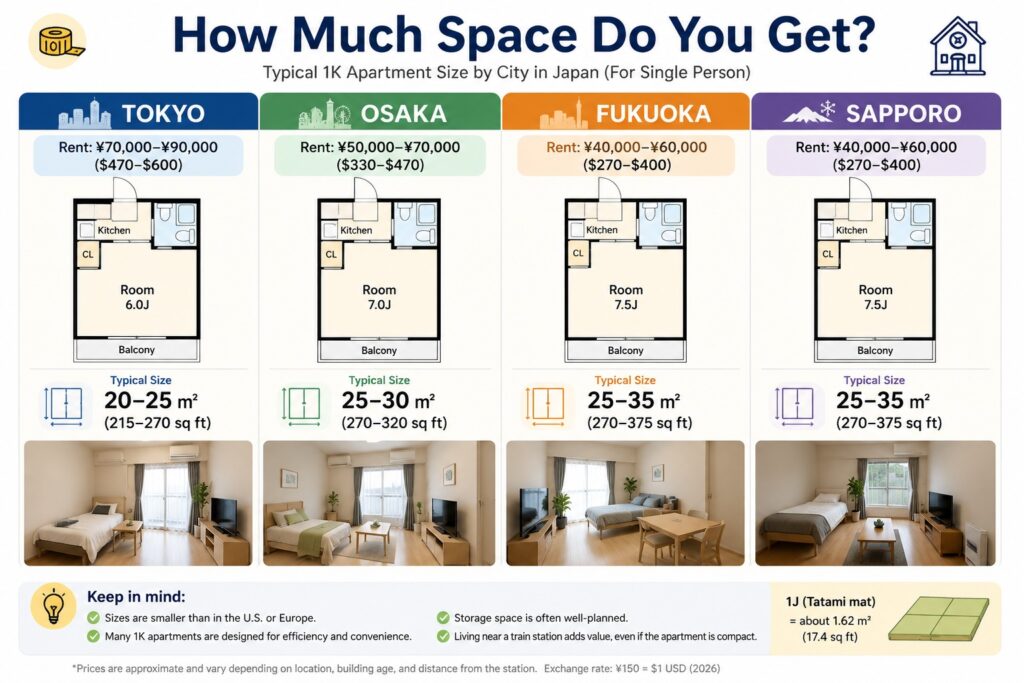
How Much Space Do You Get?
This is where many foreigners experience culture shock.
Japanese apartments are generally smaller than apartments in the United States, Canada, or Australia.
Typical apartment sizes are:
| City | Monthly Rent | Typical Size |
|---|---|---|
| Tokyo | $470–$600 | 20–25㎡ (215–270 sq ft) |
| Osaka | $330–$470 | 25–30㎡ (270–320 sq ft) |
| Fukuoka | $270–$400 | 25–35㎡ (270–375 sq ft) |
At first, these sizes may sound small.
However, Japanese apartments are usually designed around efficiency rather than spaciousness.
Many residents find that they need less space than they originally expected.
If you’re curious about why Japanese homes are often compact, you may also enjoy:
The Biggest Difference: Japan Keeps Building Housing
One reason Tokyo remains relatively affordable is simple.
Japan continues to build housing.
Many cities around the world struggle with severe housing shortages because new construction cannot keep up with demand.
Tokyo is different.
Large apartment buildings, redevelopment projects, and new housing construction continue throughout the metropolitan area.
As a result, housing supply grows alongside population demand.
This helps prevent the extreme rent inflation seen in some Western cities.
Older Buildings Become Cheaper
Another unique aspect of Japan’s housing market is how buildings are valued.
In many countries, older homes can become more valuable over time.
Japan often works differently.
As buildings age, their market value frequently declines.
This creates a large supply of older apartments available at lower rents.
For renters, that means more affordable options.
A perfectly livable apartment that is 20 or 30 years old can often cost significantly less than a newer building nearby.
Japan’s Train Network Changes Everything
Another reason rent feels more affordable is transportation.
In many countries, living farther from downtown often requires owning a car.
In Japan, trains provide a different option.
Millions of people commute daily using rail networks that connect suburbs with city centers.
Living 30 to 60 minutes from central Tokyo is completely normal.
As a result, housing demand spreads across a much larger area.
This helps reduce pressure on the city center.
You can learn more here:
Rent Alone Doesn’t Tell the Whole Story
When foreigners compare housing costs, they often focus only on monthly rent.
However, total living costs matter more.
Many Japanese neighborhoods allow residents to walk to:
- Train stations
- Supermarkets
- Convenience stores
- Restaurants
- Clinics
- Pharmacies
Because daily life is concentrated within walking distance, many households do not need a car.
That can save hundreds of dollars per month.
This is one reason why Japan can feel more affordable than rent figures alone suggest.
For a broader look at living expenses, see:
Is Rent Affordable Relative to Japanese Salaries?
Japan’s average annual salary is approximately ¥4.6 million (about $30,000 USD).
For many workers, rent typically accounts for around 20% to 30% of monthly income.
Of course, affordability depends on location, family size, and lifestyle.
But compared with many major global cities, the relationship between rent and income remains relatively balanced.
You may also be interested in:
So Why Is Tokyo Cheaper Than Many People Expect?
Most people assume a city of 37 million people should have some of the highest rents in the world.
Tokyo challenges that assumption.
A combination of:
- Continuous housing construction
- High-density development
- Extensive public transportation
- Older housing stock
helps keep rents lower than many foreigners expect.
Tokyo is certainly not cheap by Japanese standards.
But compared with many large Western cities, it often offers surprisingly good value.
For many newcomers, the biggest surprise about Japan is not how expensive it is.
It’s how affordable it can be.
Related Articles
Living Cost in Japan for Foreigners (2026 Guide)
https://japan-life-blog.com/archives/736
Is ¥6 Million a Good Salary in Japan?
https://japan-life-blog.com/archives/780
Why Japanese Apartments Feel So Small
https://japan-life-blog.com/archives/1009
Why Tokyo Works Without Cars
https://japan-life-blog.com/archives/1024
Hidden Costs of Renting an Apartment in Japan
https://japan-life-blog.com/archives/805