
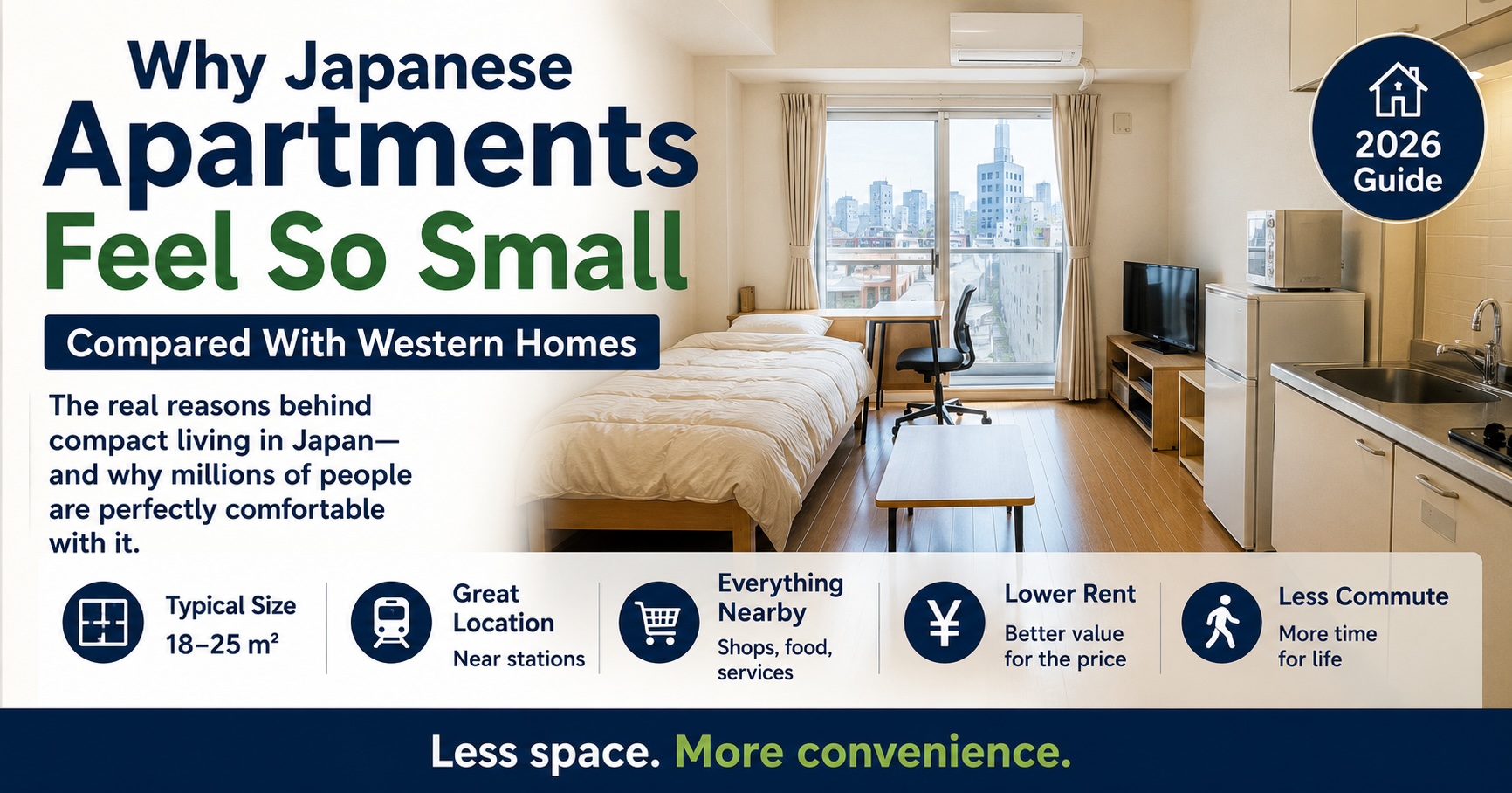
If you visit Japan for the first time, one thing often stands out immediately.
The apartments feel surprisingly small.
Even foreigners who expect compact living are sometimes shocked when they step inside a typical apartment in Tokyo.
A common reaction is:
“That’s it?”
Compared with homes in the United States, Canada, Australia, and many parts of Europe, Japanese apartments can feel remarkably compact.
But the interesting question is not simply why Japanese apartments are small.
The bigger question is:
Why do they feel so much smaller than Western homes?
And perhaps even more importantly:
Why are millions of people perfectly comfortable living in them?
After living in Japan for more than four decades, I have noticed that many foreigners focus on square footage first, while many Japanese people focus on convenience first.
This difference explains much of Japan’s housing reality.
In this article, we’ll explore:
- What foreigners notice first about Japanese apartments
- How large a typical Tokyo apartment actually is
- Why apartments became so compact
- Why many Japanese people willingly accept smaller homes
- Why small apartments often work better than foreigners expect
What Foreigners Notice First
When foreigners describe Japanese apartments as “small,” they are usually not talking about just one thing.
Instead, several design differences combine to create that impression.
Many first-time visitors immediately notice:
- Smaller bedrooms
- Compact kitchens
- Tiny bathrooms
- Limited storage space
- Narrow hallways
- Lower ceilings in some older buildings
Individually, none of these features seem particularly dramatic.
But together, they can make an apartment feel much smaller than its actual floor area.
This is especially noticeable for people coming from countries where larger kitchens, larger bathrooms, and larger living rooms are considered normal.
A Typical Tokyo Apartment Is Smaller Than Many People Expect
Let’s start with the numbers.
A typical single-person apartment in central Tokyo is often around:
18–25㎡ (193–269 sq ft)
For many foreigners, that sounds incredibly small.
And honestly, compared with many Western apartments, it is.
However, numbers alone don’t tell the whole story.
A 20㎡ apartment can usually fit:
- A single bed
- A small desk
- A television stand
- A refrigerator
- A compact storage unit
Technically, everything fits.
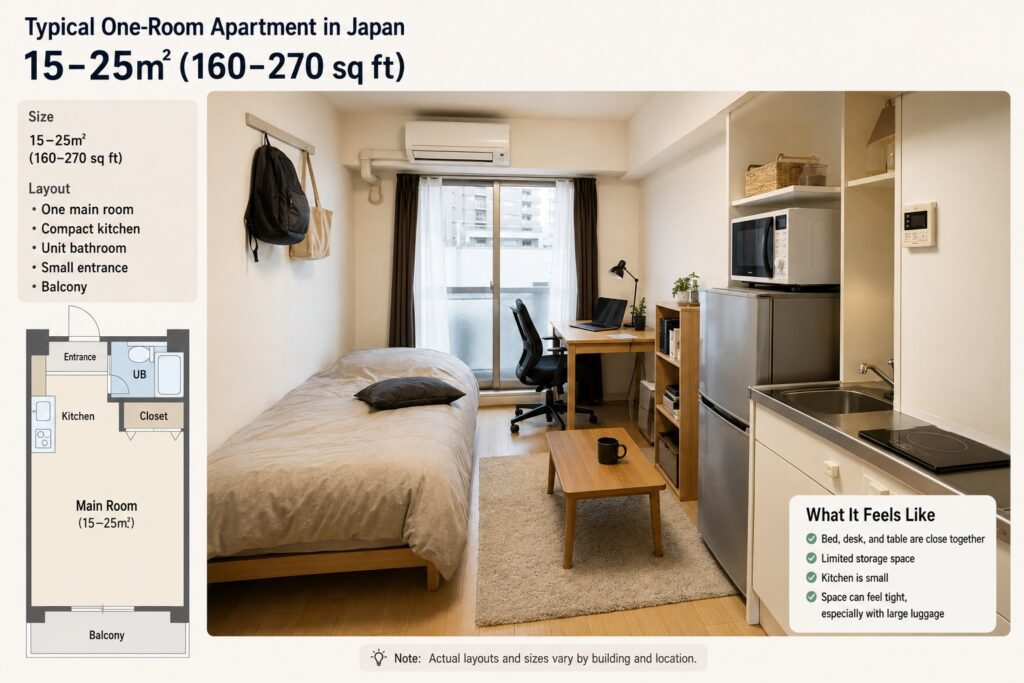
But the room can begin to feel crowded surprisingly quickly.
As a Japanese person, my personal feeling is that a small bedroom-sized space is usually enough for one person.
However, once you place a bed, a table, and a television stand inside, the room often starts to feel noticeably cramped.
You can absolutely live comfortably there.
But you are always aware of the limited space.
In contrast, apartments with enough room for a larger bedroom and a separate living area feel significantly more relaxed and comfortable.
The downside is obvious.
More space almost always means higher rent.
This trade-off is something nearly everyone in Japan thinks about when choosing where to live.
If you would like a detailed breakdown of apartment sizes in Japan, see:
Average Apartment Size in Japan (2026): How Small Are Japanese Apartments Really?
Small Kitchens Make Apartments Feel Smaller
One of the biggest surprises for foreigners is often the kitchen.
Many Japanese apartments have kitchens that are much smaller than those found in Western homes.
In some apartments, the kitchen may consist of:
- A single sink
- A two-burner stove
- Minimal counter space
For someone accustomed to a large kitchen island or extensive countertop space, this can feel shocking.
However, Japanese kitchens are usually designed around efficiency rather than entertaining.
Many people shop frequently because supermarkets and convenience stores are nearby.
Storage space is often minimized because people buy food more frequently rather than storing large quantities.
Related:
Why Tokyo Apartments Have Tiny Kitchens
Compact Bathrooms Add to the Feeling
Bathrooms create a similar impression.
Many foreigners are surprised by how compact Japanese bathrooms can be.
A typical bathroom may combine:
- A bathtub
- A shower
- A sink
- A toilet
into a very small space.
While highly functional, these bathrooms often feel tiny compared with Western standards.
This contributes significantly to the overall impression that the apartment itself is extremely small.
Related:
Why Japanese Bathrooms Are So Compact
Why Japanese Apartments Became So Small
The biggest reason is geography.
Approximately 75% of Japan’s land area is mountainous.
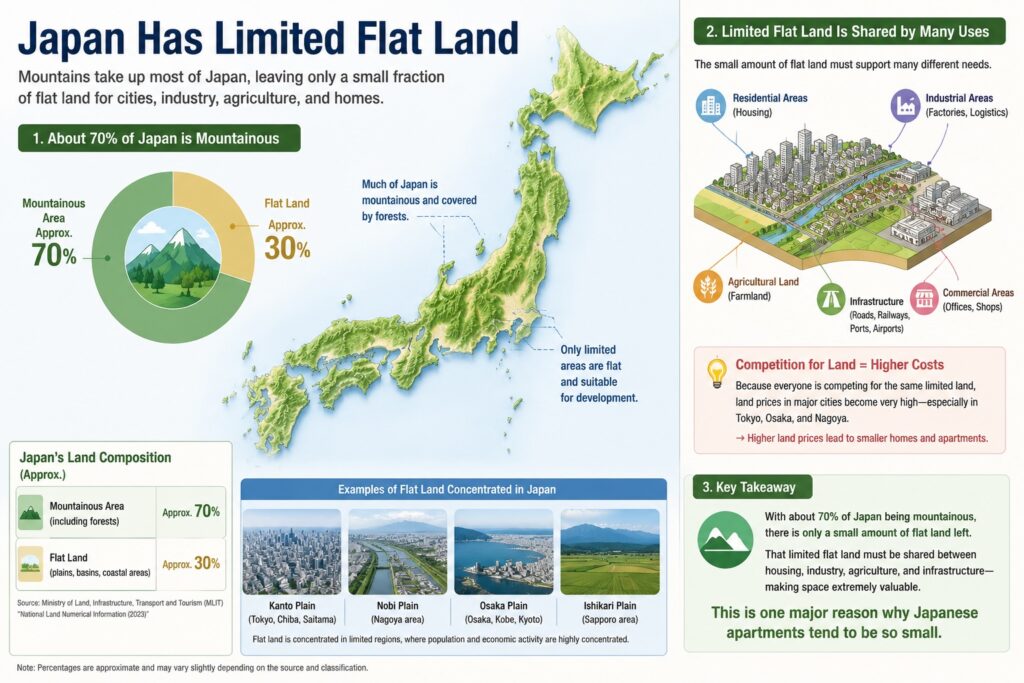
That leaves a relatively limited amount of flat land for:
- Housing
- Industry
- Agriculture
- Transportation infrastructure
At the same time, much of Japan’s population and economic activity is concentrated in a few major metropolitan areas.
Tokyo alone attracts millions of workers, students, and businesses.
As demand for housing rises, land becomes increasingly valuable.
Developers then face a simple choice.
They can build larger apartments with higher rents, or smaller apartments that more people can afford.
For decades, Japanese cities largely chose the second option.
The result is a housing market where location often becomes more valuable than floor space itself.
The Real Trade-Off: Space vs Convenience
This is the part many foreigners overlook.
When people compare apartment sizes across countries, they often compare only the home itself.
But in Japan, many people view their neighborhood as an extension of their living space.
A typical resident in Tokyo may live within walking distance of:
- A train station
- A supermarket
- A convenience store
- A pharmacy
- Restaurants
- Cafés
- Parks
- Fitness centers
In many cases, everything needed for daily life is only a few minutes away.
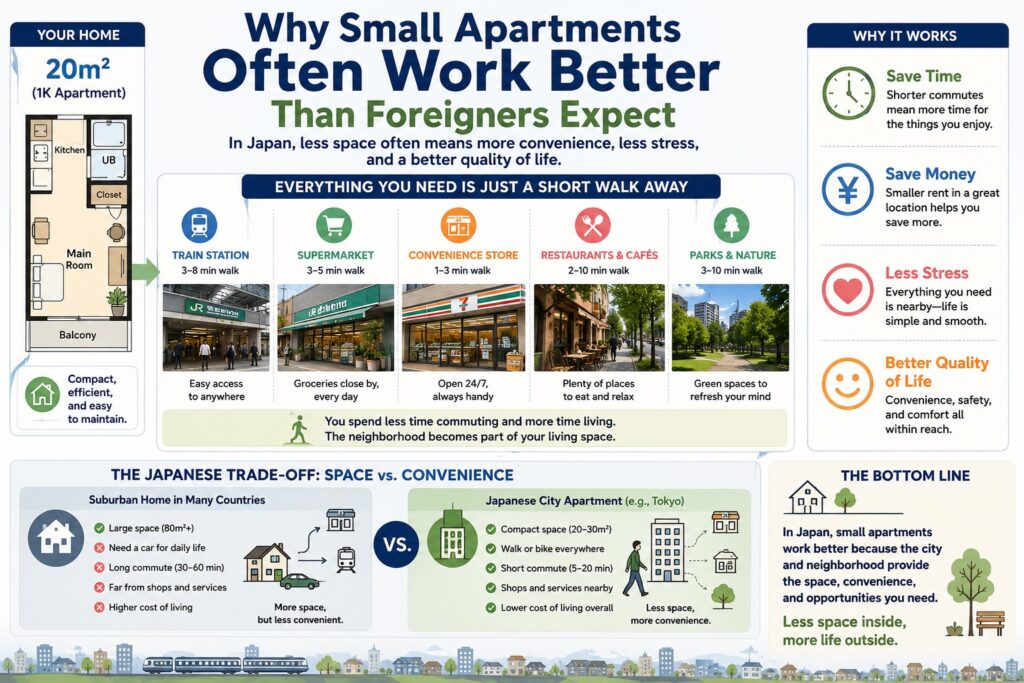
This creates a very different lifestyle from suburban areas in countries where a car is necessary for nearly every errand.
Because so much is available nearby, people often spend less time commuting and less time maintaining large homes.
Instead, they gain access to an entire neighborhood full of amenities.
This is one reason many Japanese residents willingly accept smaller apartments.
The trade-off is often:
Less space, more convenience.
If you’re interested in how transportation shapes Japanese lifestyles, you may also enjoy:
Why Millions of People Are Fine With It
One common misconception is that Japanese people prefer small apartments.
That is not really true.
Most people would happily choose a larger home if money were not a factor.
However, housing decisions always involve trade-offs.
When choosing where to live, many people prioritize:
- A shorter commute
- Lower rent
- Train access
- A convenient neighborhood
- Proximity to work or school
As a result, many people decide that sacrificing some living space is worth the benefits.
This is especially true in Tokyo.
A larger apartment located far from the city center may require significantly longer commuting times.
Meanwhile, a smaller apartment near a train station can provide easier access to work, shopping, entertainment, and social activities.
For many residents, convenience ultimately provides more value than additional square meters.
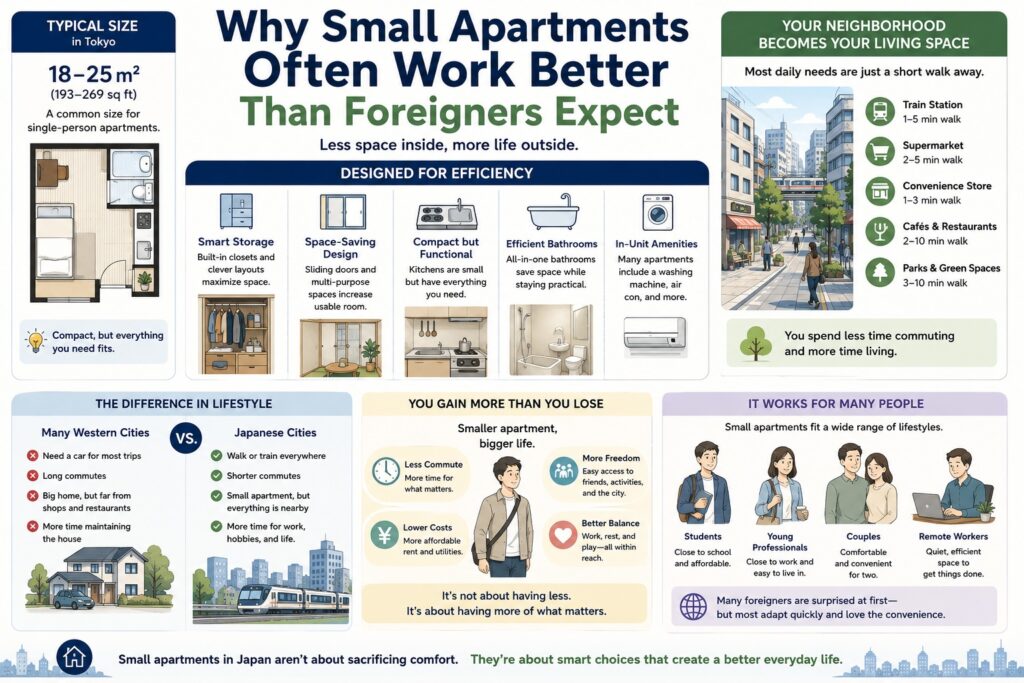
Why Small Apartments Often Work Better Than Foreigners Expect
Many foreigners arrive in Japan expecting compact apartments to be uncomfortable.
Sometimes they are.
But surprisingly, many people adapt faster than they expect.
One reason is that Japanese apartments are often designed around efficiency.
Features commonly include:
- Built-in storage
- Sliding doors
- Space-saving furniture layouts
- Multi-purpose rooms
- Compact but functional kitchens
Another reason is that daily life itself is structured differently.
Many Japanese people spend relatively little time at home compared with residents of some lower-density countries.
Work, school, shopping, dining, and recreation often occur within highly walkable urban environments.
Because cities are designed around public transportation and convenience, large amounts of private space become less essential.
This does not mean small apartments are always ideal.
Families, remote workers, and people with space-intensive hobbies often prefer larger homes.
However, many single workers and couples find that a compact apartment meets their needs surprisingly well.
Related:
Why Small Homes Actually Work in Japan
Will Japanese Apartments Become Larger in the Future?
Remote work has already started changing housing preferences.
Some younger workers now prioritize:
- Extra rooms
- Home office space
- Better insulation
- Larger living areas
As remote and hybrid work become more common, some people are choosing suburban locations where larger apartments are more affordable.
However, central Tokyo remains one of the country’s most important economic centers.
As long as demand for living near major train stations and business districts remains strong, compact apartments are likely to remain a major part of Japan’s housing market.
Final Thoughts
Japanese apartments feel small compared with many Western homes.
But the difference is not simply about floor area.
Smaller kitchens, compact bathrooms, limited storage, expensive urban land, and a strong preference for convenience all contribute to the feeling.
Many foreigners initially focus on what Japanese apartments lack.
Over time, many begin noticing what Japanese cities provide instead.
Walkability.
Public transportation.
Convenience.
Access to daily necessities.
Shorter travel times.
The result is a housing system that often prioritizes practicality over spaciousness.
Japanese apartments may be smaller than many foreigners expect.
But once you understand the trade-offs, they often make much more sense.
Less space.
More convenience.
For millions of people in Japan, that is a trade worth making.