
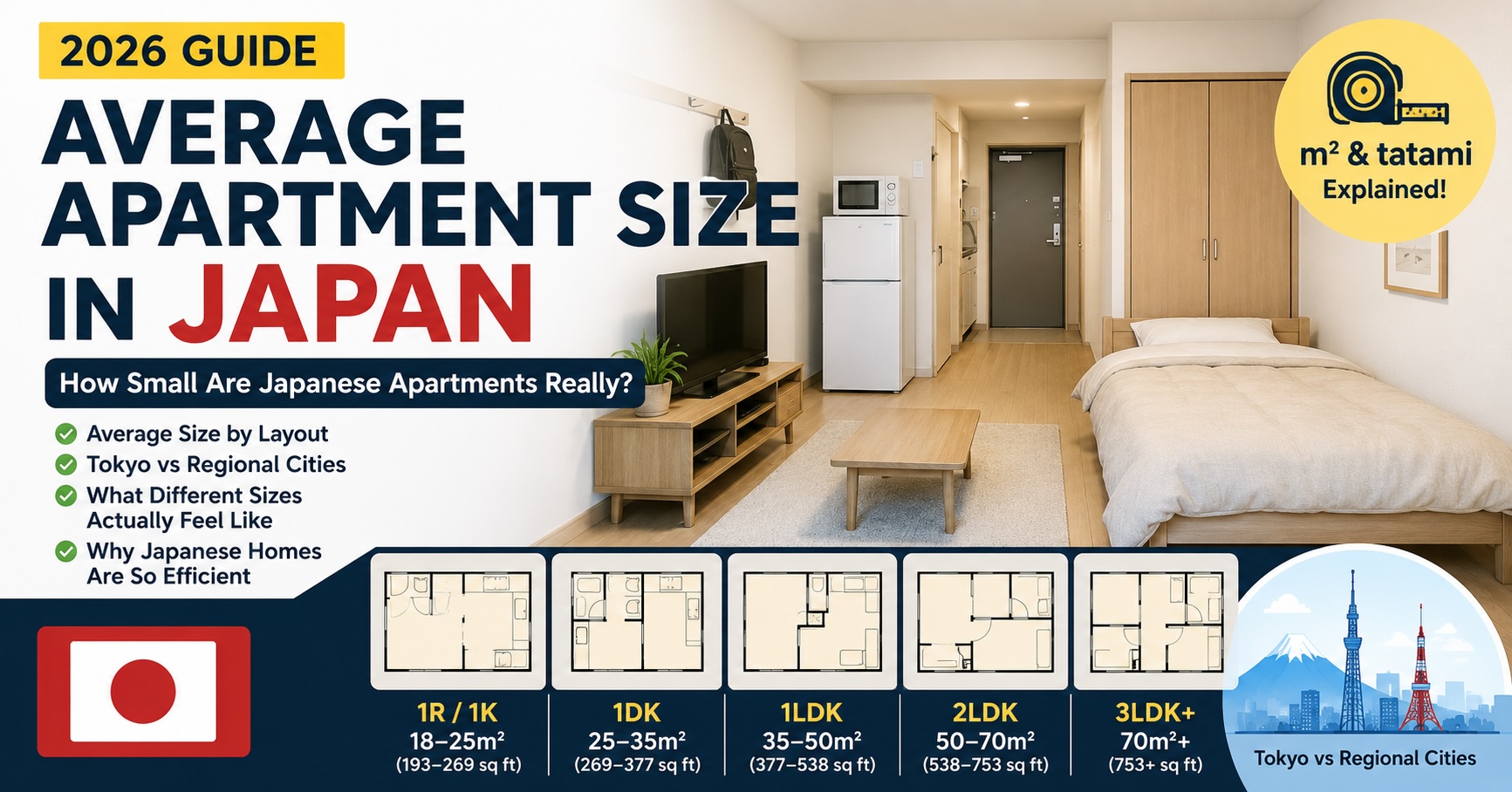
If you are planning to move to Japan, one question often comes up before signing a lease:
How big are Japanese apartments actually?
You have probably heard stories about tiny Tokyo apartments where the bed nearly touches the kitchen.
Some of those stories are true.
But many foreigners are surprised to discover that apartment sizes in Japan vary far more than they expected.
While compact one-room apartments are common in central Tokyo, family apartments and suburban homes can be significantly larger.
More importantly, apartment size alone does not tell the whole story.
Japanese homes are often designed differently from those in North America, Australia, and Europe. Layout efficiency, public transportation, neighborhood convenience, and housing costs all influence how much living space people actually need.
Having lived in Japan for decades, I would say many foreigners focus on square footage first, while many Japanese people focus on location first.
This difference explains much of Japan’s housing market.
In this guide, we will look at:
- The average apartment size in Japan
- Typical sizes by apartment layout
- Tokyo versus regional cities
- What different apartment sizes actually feel like
- Why Japanese apartments are often smaller than Western homes
- Whether small apartments are really as inconvenient as they seem
What Is the Average Apartment Size in Japan?
The answer depends heavily on location, household size, and apartment type.
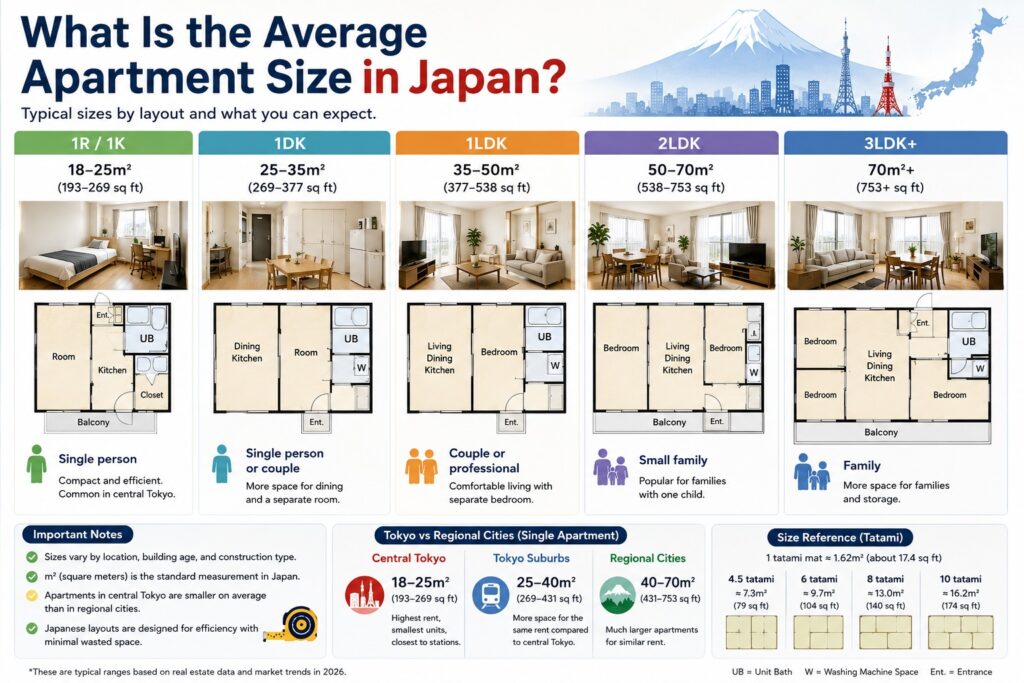
As a rough guideline, these are the sizes most people encounter:
| Layout | Typical Size | Typical Occupants |
|---|---|---|
| 1R / 1K | 18–25㎡ (193–269 sq ft) | Single person |
| 1DK | 25–35㎡ (269–377 sq ft) | Single person or couple |
| 1LDK | 35–50㎡ (377–538 sq ft) | Couple or professional |
| 2LDK | 50–70㎡ (538–753 sq ft) | Small family |
| 3LDK+ | 70㎡+ (753+ sq ft) | Family |
For many foreigners, the biggest surprise is the size of single-person apartments.
A 20㎡ apartment may sound extremely small compared with apartments in the United States, Canada, or Australia.
However, in Tokyo, this is completely normal.
Millions of people live comfortably in apartments of this size.
Understanding Japanese Apartment Layouts
When looking for housing in Japan, you will often see abbreviations such as:
- 1R
- 1K
- 1DK
- 1LDK
- 2LDK
- 3LDK
These labels describe both room count and layout.
- R = Room
- K = Kitchen
- DK = Dining Kitchen
- LDK = Living Dining Kitchen
For example:
1K means one main room plus a separate kitchen area.
1LDK means one bedroom plus a dedicated living and dining area.
This distinction matters because two apartments with similar floor areas can feel completely different depending on how the space is divided.
Average Apartment Size in Tokyo vs Regional Cities
One mistake many foreigners make is assuming all of Japan looks like central Tokyo.
It does not.
Tokyo is by far the country’s most expensive housing market, and apartment sizes reflect that reality.
| Location | Typical Single Apartment |
|---|---|
| Central Tokyo | 18–25㎡ |
| Tokyo Suburbs | 25–40㎡ |
| Regional Cities | 40–70㎡ |
In many regional cities, you can rent an apartment that is nearly twice the size of a central Tokyo apartment for a similar monthly rent.
This is one reason many Japanese people move away from major cities when they start families.
If you are interested in housing costs, you may also want to read:
What Does a 20㎡ Apartment Actually Feel Like?
This is where most articles stop.
They tell you the size.
But they do not explain what the size actually feels like.
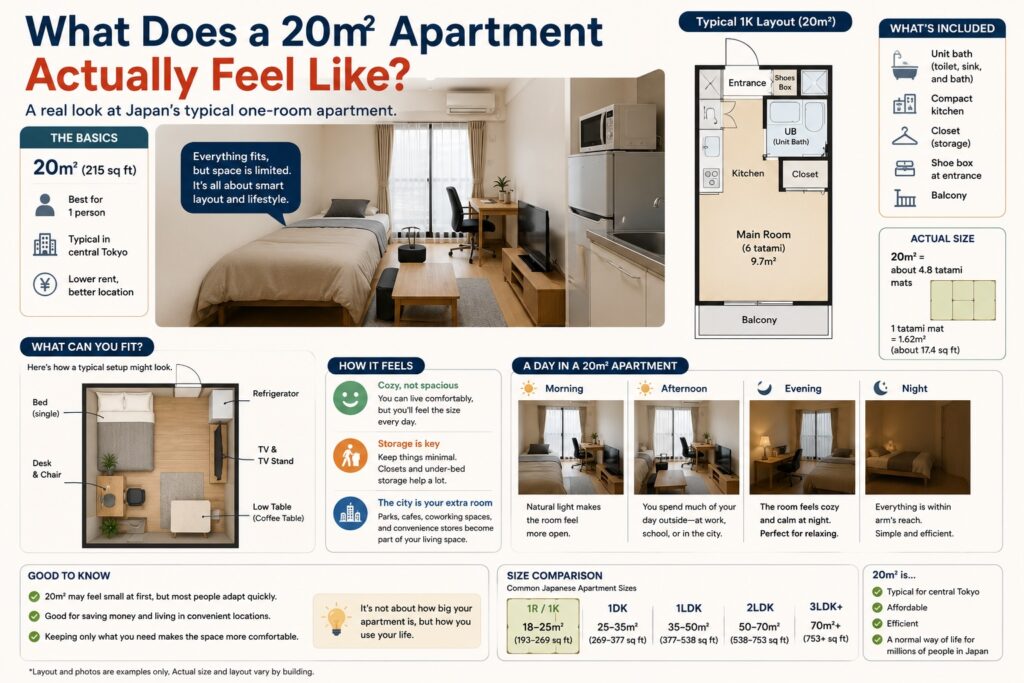
A typical 20㎡ apartment can usually fit:
- A single bed
- A small desk
- A television stand
- A refrigerator
- A compact storage unit
Technically, everything fits.
But the room can start to feel crowded surprisingly quickly.
As a Japanese person, my personal feeling is that a 20㎡ apartment is usually enough for one person.
You can fit all the essentials and live comfortably.
However, once you add a bed, a desk, a dining table, storage furniture, and other daily necessities, there is often very little open floor space left.
You may find yourself walking around furniture rather than through the room.
In contrast, apartments around 30㎡ to 40㎡ often feel much more comfortable.
There is enough room for separate living, sleeping, and working areas, which makes everyday life feel less cramped.
The downside is obvious.
More space usually means higher rent.
This trade-off is something almost everyone in Japan thinks about when choosing where to live.
Why Foreigners Often Think Japanese Apartments Are Tiny
Part of the answer is simple comparison.
Many foreigners compare Japanese apartments with:
- American suburban apartments
- Canadian condominiums
- Australian apartments
- European family homes
Under those comparisons, Japanese apartments often appear small.
However, Japan developed under very different conditions.
About three-quarters of Japan’s land area is mountainous, leaving a relatively limited amount of flat land for cities, housing, industry, and agriculture. This contributes to higher land competition in major urban areas.
At the same time, population and economic activity are heavily concentrated in metropolitan regions such as Tokyo and Osaka.
When land becomes expensive, housing developers face difficult trade-offs.
Most people would rather live close to work than spend hours commuting every day.
As a result, apartment sizes tend to shrink while location becomes more valuable.
This is one of the main reasons Japanese apartments often feel smaller than homes in lower-density countries.
Why Small Apartments Often Work Better Than Foreigners Expect
Many foreigners arrive in Japan expecting small apartments to be uncomfortable.
Sometimes they are.
But surprisingly, many people adapt faster than they expect.
The reason is that Japanese apartments were not designed in isolation.
They were designed as part of a broader urban system.
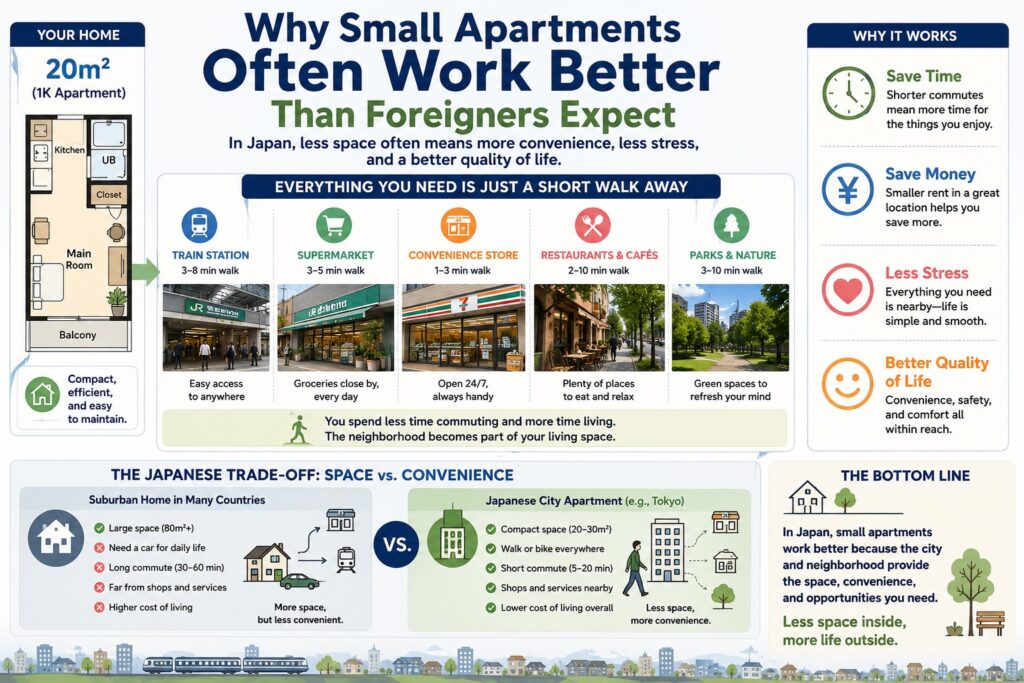
In many parts of Tokyo, daily necessities are only a few minutes away.
- Convenience stores
- Supermarkets
- Drug stores
- Restaurants
- Cafés
- Train stations
- Parks
Because so much of daily life happens outside the home, apartments do not need to accommodate every activity.
This creates a very different lifestyle compared to suburban areas in countries where driving is required for almost every errand.
Many foreigners initially focus on apartment size.
After a few months, many begin focusing more on location and convenience.
This is exactly the trade-off many Japanese residents make.
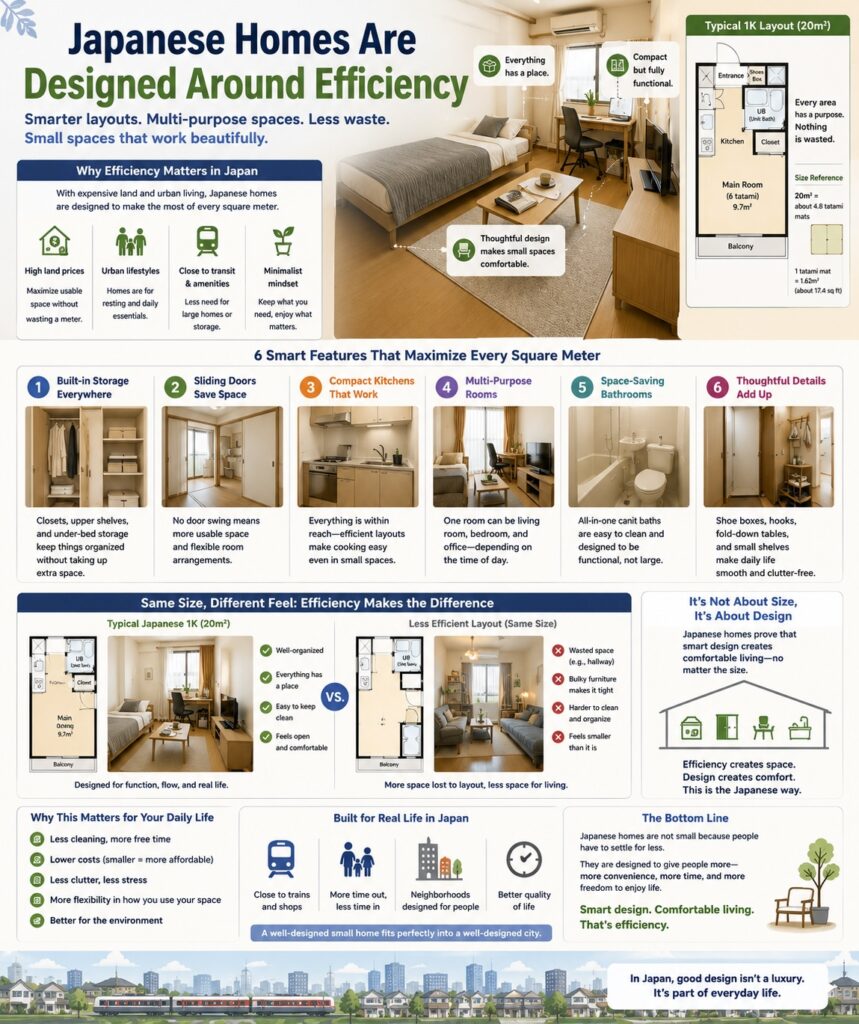
Japanese Homes Are Designed Around Efficiency
Another important factor is efficiency.
Japanese apartments often include features specifically designed to maximize usable space.
- Built-in storage
- Sliding doors
- Compact kitchens
- Multi-purpose rooms
- Space-saving bathrooms
Western homes sometimes prioritize spacious rooms.
Japanese homes often prioritize practical layouts.
This is why a 40㎡ apartment in Japan may feel more functional than a similarly sized apartment elsewhere.
If you are interested in these design differences, you may also enjoy:
- Why Tokyo Apartments Have Tiny Kitchens
- Why Japanese Bathrooms Are So Compact
- Why Small Homes Actually Work in Japan
The Hidden Difference Between Japan and Many Western Countries
One of the biggest differences is how people use their homes.
In many Western countries, larger homes often serve multiple purposes.
- Entertainment space
- Guest rooms
- Home offices
- Large storage areas
- Dedicated dining rooms
Japanese homes traditionally evolved differently.
For decades, many people prioritized:
- Shorter commutes
- Access to train stations
- Convenient neighborhoods
- Affordable housing costs
As discussed in Why Japanese Apartments Feel So Small, location often became more important than maximizing living space.
This does not mean Japanese people dislike larger homes.
Most people would happily choose a larger apartment if cost were not a factor.
However, housing decisions usually involve balancing:
- Space
- Rent
- Commute time
- Neighborhood quality
In expensive cities such as Tokyo, space is often the variable that gets reduced.
Are Japanese Apartments Getting Larger or Smaller?
The answer is complicated.
Modern Japanese apartments often offer better layouts than older buildings.
However, rising construction costs and land prices have encouraged developers to keep apartment sizes relatively compact.
As property prices increased throughout the Tokyo metropolitan area, many new developments focused on improving efficiency rather than dramatically increasing floor space.
Remote work has also changed housing preferences.
Some younger workers now place greater value on:
- Extra rooms
- Home office space
- Larger living areas
- Suburban locations
Even so, compact apartments remain extremely common, particularly near major train stations and employment centers.
So, How Small Are Japanese Apartments Really?
The honest answer is:
Smaller than many foreigners expect, but often more practical than they imagine.
A typical Tokyo studio may only measure 18–25㎡.
A typical family apartment may range from 50–70㎡.
Compared to many Western countries, these numbers can seem surprisingly low.
Yet millions of people live comfortably in these homes every day.
The reason is that apartment size is only one part of the equation.
Transportation, neighborhood design, public infrastructure, and efficient layouts all help make smaller living spaces workable.
When foreigners first see the numbers, they often focus on what is missing.
After living in Japan for a while, many start noticing what the surrounding city provides.
That shift in perspective is one reason Japanese apartment sizes make more sense once you experience daily life here.
Final Thoughts
Japanese apartments are undeniably smaller than many homes found in North America, Australia, and parts of Europe.
But this is not simply because Japan is crowded.
Apartment sizes reflect a combination of:
- Limited flat land
- High urban land prices
- Dense cities
- Train-centered lifestyles
- Efficiency-focused housing design
Understanding these factors helps explain why compact apartments became normal throughout much of Japan.
For many residents, the trade-off is simple:
Less space, but better access to everything else.
And for many people living in Tokyo, that trade-off is worth making.