
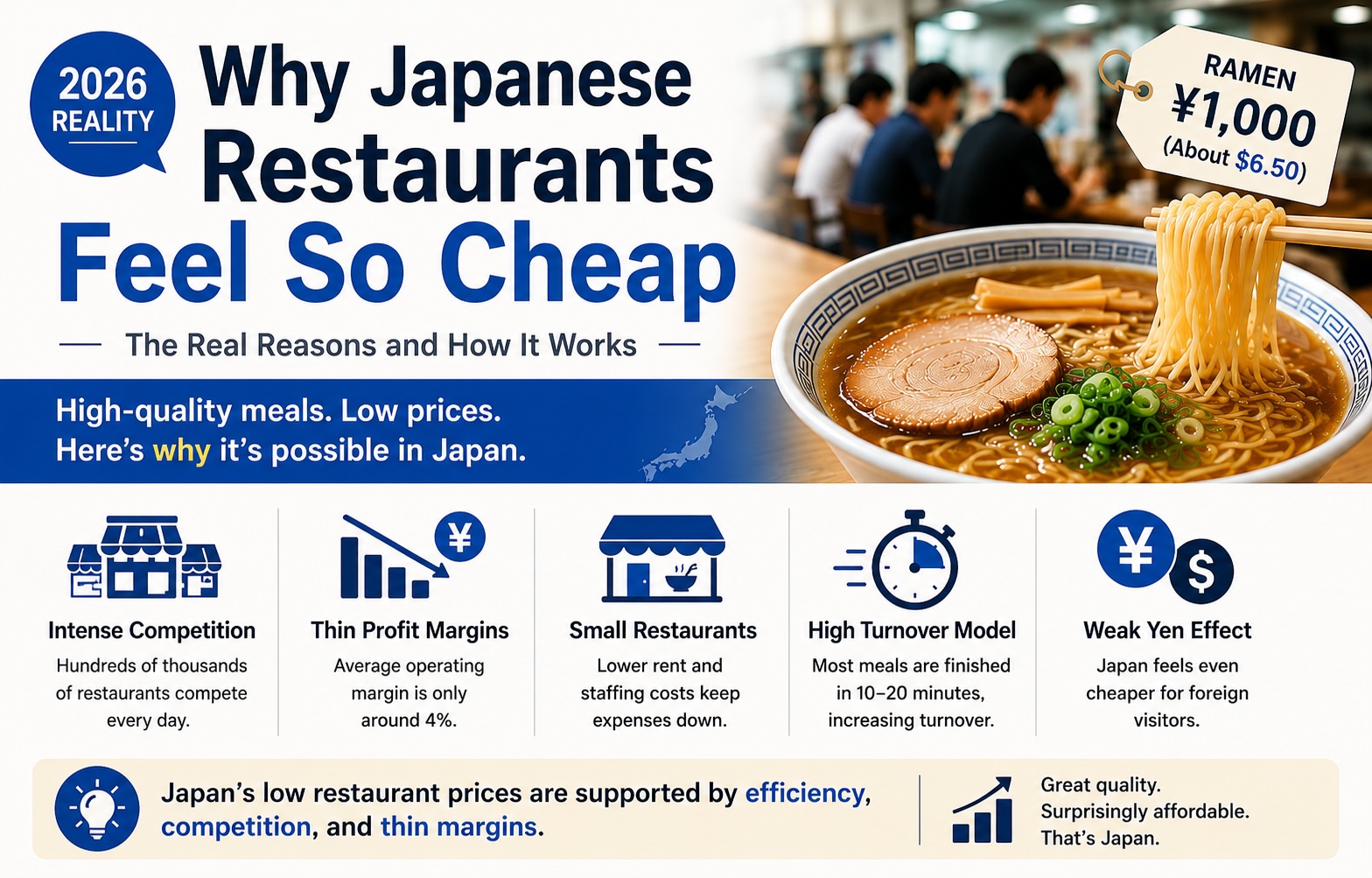
Many foreigners visiting Japan experience the same reaction:
“Why is restaurant food in Japan so cheap?”
In cities like Tokyo or Osaka, it is still common to find:
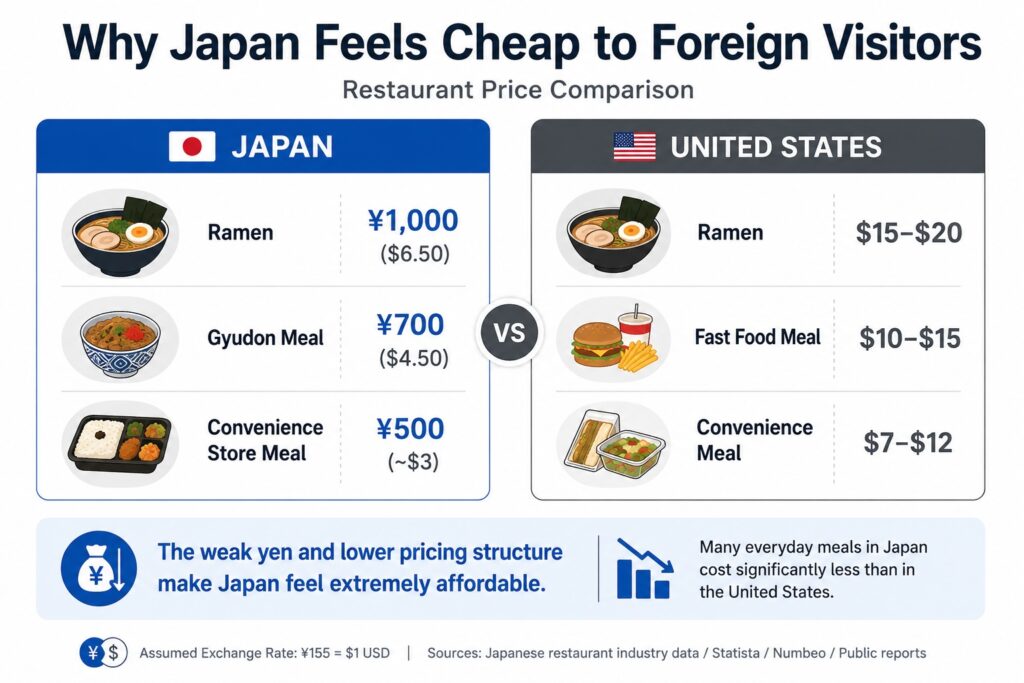
- Ramen for ¥800–¥1,200 (about $5–$8)
- Gyudon meals under ¥700 (about $4.50)
- Lunch sets near ¥1,000 (about $6.50)
- Convenience store meals under ¥600 (about $4)
Assumed exchange rate: ¥155 = $1 USD
For visitors coming from the United States, Canada, Australia, or parts of Europe, Japan’s restaurant prices often feel surprisingly affordable.
But this raises an important question:
How can restaurants stay so cheap in a developed country?
The answer is more complicated than many people realize.
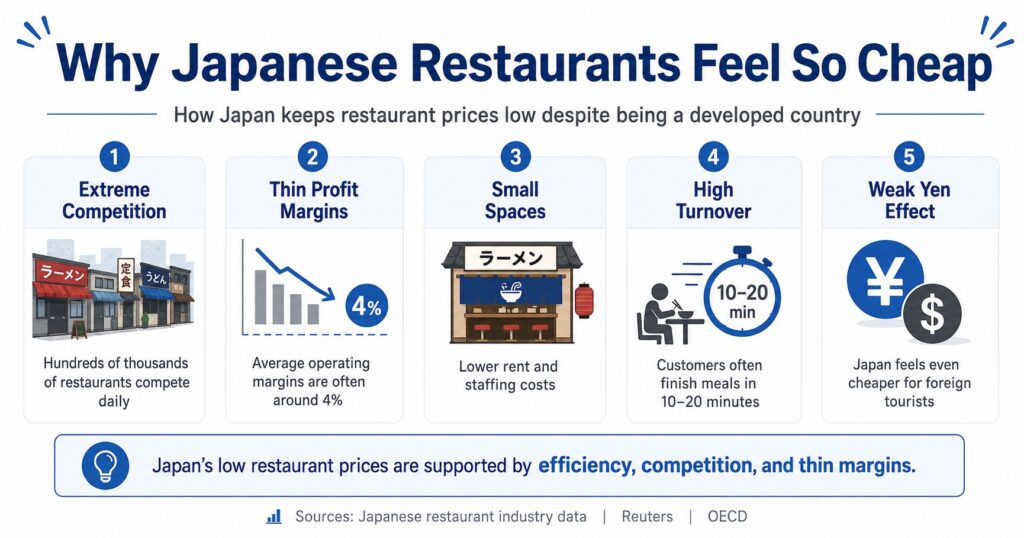
Japan Has One of the World’s Most Competitive Restaurant Markets
One major reason is competition.
Japan has one of the world’s largest restaurant industries.
Industry estimates suggest Japan has more than 500,000 food-service establishments nationwide.
Tokyo alone is considered one of the most restaurant-dense cities in the world.
In large urban areas:
- Restaurants exist near almost every train station
- Small eateries compete side-by-side
- Consumers have endless alternatives
This creates extremely intense price competition.
If prices rise too aggressively, customers can easily choose another nearby restaurant within minutes.
As a result, many restaurants operate with very thin profit margins.
Restaurant Profit Margins Are Surprisingly Low
Many foreigners assume Japanese restaurants must be highly profitable because customer traffic is so strong.
In reality, margins are often extremely small.
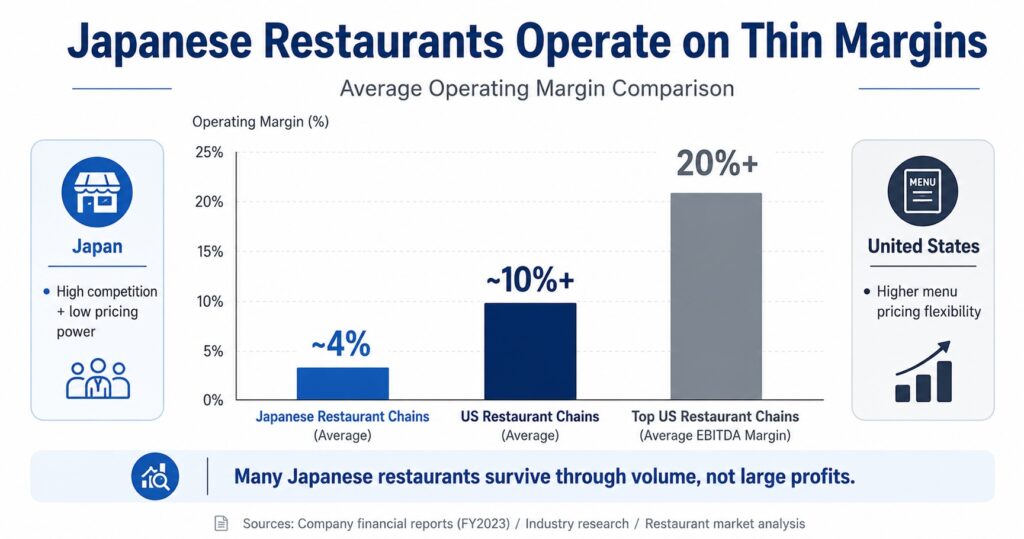
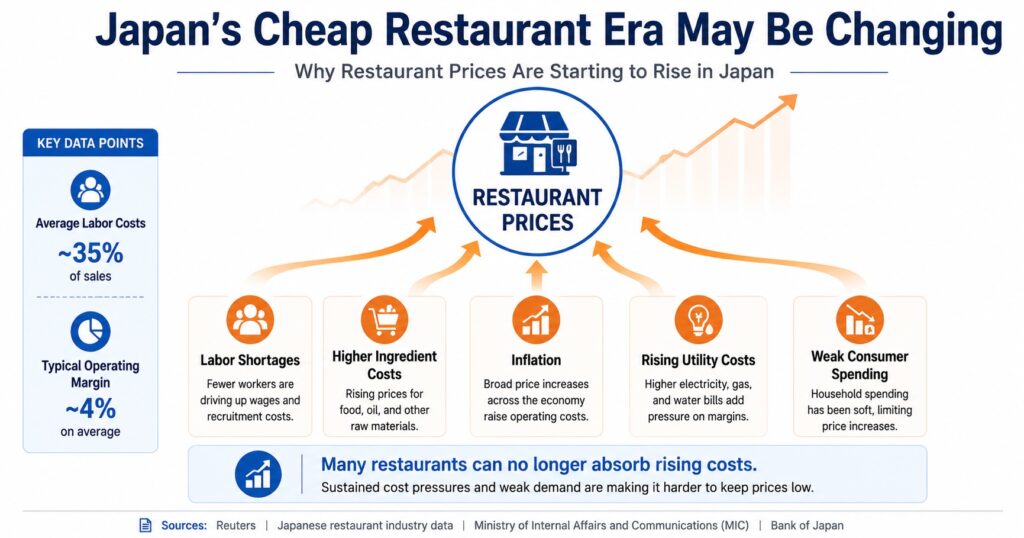
Recent industry analysis showed that listed Japanese restaurant companies averaged operating profit margins of roughly 4.1% in 2023.
Independent restaurants often operate at similarly thin levels.
For comparison:
- Many US restaurant chains historically targeted margins above 10%
- Top US listed restaurant chains once averaged EBITDA margins above 20%
- Japanese restaurant chains averaged below 7% in comparable studies
This means Japanese restaurants depend heavily on:
- high customer turnover
- efficient operations
- stable daily traffic
rather than large profits per customer.
Japanese Consumers Became Extremely Price Sensitive
Japan experienced decades of low inflation after the collapse of the bubble economy in the 1990s.
During this long period of weak inflation:
- consumers became highly price conscious
- restaurants hesitated to raise prices
- cheap lunch culture became deeply rooted
Even today, many office workers still expect affordable lunch options around ¥500–¥1,000 ($3–$6.50).
Related: Why Japanese Salaries Increase So Slowly
Restaurant Portions Are Often Smaller
Another important factor is portion size.
Compared to the United States especially, Japanese restaurant portions are often smaller.
This helps restaurants control:
- ingredient costs
- food waste
- inventory management
Many Japanese meals are designed to be:
- balanced
- efficient
- quick to prepare
This helps restaurants maintain lower operating costs while keeping prices accessible.
Many Restaurants Operate in Extremely Small Spaces
Many Japanese restaurants are physically much smaller than Western restaurants.
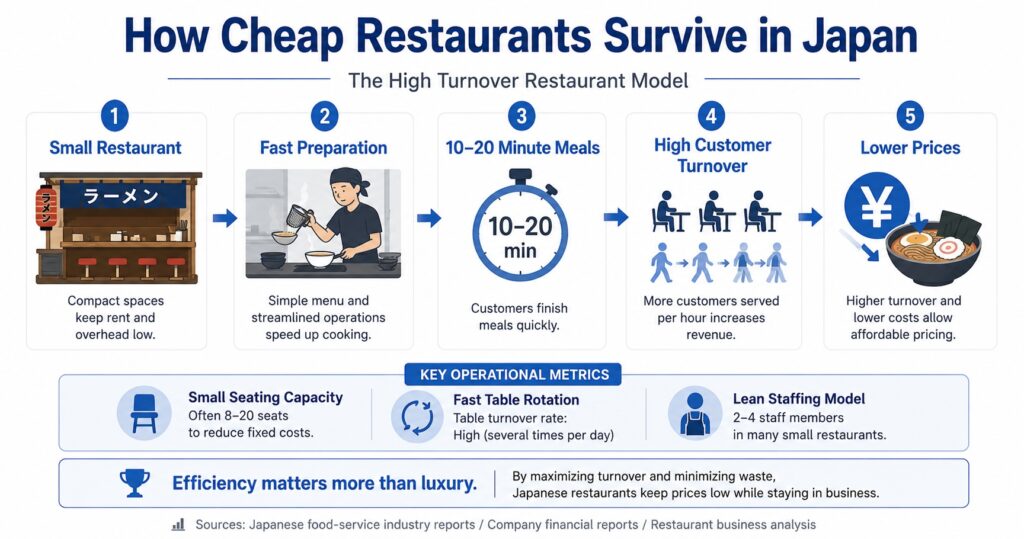
Some ramen shops or izakayas may only seat:
- 8 people
- 10 people
- 15 people
Smaller spaces reduce:
- rent costs
- staffing requirements
- utility expenses
At the same time, Japan’s dense cities allow restaurants to maintain steady customer flow despite limited seating.
This high efficiency per square meter is one reason Japan can sustain relatively low restaurant prices.
Related: Is Fukuoka Cheaper Than Tokyo?
Japan’s Restaurant Model Depends on High Turnover
Many affordable restaurant chains in Japan focus on high customer turnover instead of large profit margins per meal.
Examples include:
- Gyudon chains
- Ramen chains
- Udon restaurants
- Conveyor belt sushi
These businesses focus on:
- fast service
- efficient preparation
- high customer volume
Some chain restaurants are designed so customers finish meals within 10–20 minutes.
This operating model helps keep menu prices relatively low.
For example:
- Sukiya operates more than 2,000 stores in Japan
- Gyoza no Ohsho operates more than 700 restaurants nationwide
- Skylark Holdings operates more than 2,700 restaurants globally
Scale and operational efficiency are critical to maintaining low prices.
Labor Costs Historically Stayed Lower
Another uncomfortable reality is labor costs.
Compared to the United States and some Western countries, Japanese wages grew much more slowly over the past few decades.
This affected restaurant pricing directly.
For many years, restrained wage growth helped restaurants avoid dramatic menu price increases.
However, this situation is now changing due to labor shortages.
Recent industry statistics showed that wage costs in Japan’s restaurant industry rose to around 35% of sales on average.
Reuters also reported that labor shortages are increasingly forcing Japanese businesses to raise wages and prices.
Related: Japan vs US Salary Structure
Convenience Stores Changed Food Expectations
Japan’s convenience stores also play an important role in food pricing culture.
Chains such as:
- 7-Eleven
- Lawson
- FamilyMart
offer:
- cheap bento meals
- rice balls
- fried food
- sandwiches
- pasta
Many convenience store meals still cost roughly ¥300–¥700 ($2–$4.50).
Because consumers always have access to affordable prepared food, restaurants face additional pressure to keep prices reasonable.
Many Restaurants Are Actually Struggling Financially
Cheap prices do not necessarily mean restaurants are highly profitable.
In reality, many Japanese restaurants face serious financial pressure due to:
- rising ingredient costs
- labor shortages
- higher utility bills
- weak consumer spending
Recent Reuters reporting showed that Japan’s service sector growth slowed significantly as businesses faced rising fuel, staffing, and raw material costs.
At the same time, Japanese household spending recently fell 2.9% year-over-year, increasing pressure on restaurants that rely heavily on stable daily customers.
Some ramen shops have even struggled to raise prices above ¥1,000 ($6.50) because customers remain psychologically sensitive to that price level.
The Weak Yen Made Japan Feel Even Cheaper
For foreign tourists, Japan currently feels even cheaper because of exchange rates.
The weak yen significantly increased Japan’s affordability for visitors earning US dollars or euros.
A meal that feels normal to Japanese customers may feel extremely inexpensive to someone earning foreign currency.
This exchange-rate effect became especially noticeable after the yen weakened sharply against the US dollar after 2022.
Japan’s Food Culture Prioritizes Accessibility
One important cultural factor is often overlooked:
Japan historically treated affordable restaurant food as part of everyday life.
Many restaurants aim to provide:
- quick meals
- consistent quality
- reasonable prices
Affordable eating out became deeply integrated into urban Japanese life.
In many Western countries, restaurant dining is viewed as a more occasional expense.
In Japan, inexpensive restaurant meals became part of daily routine for millions of workers.
Final Thoughts
Japanese restaurants feel surprisingly cheap because several factors combine together:
- extreme competition
- small restaurant spaces
- high customer turnover
- slow wage growth
- price-sensitive consumers
- efficient operations
- weak yen effects for tourists
However, the situation is slowly changing.
Inflation, labor shortages, and rising operating costs are now forcing many restaurants to increase prices for the first time in years.
Even so, compared to many Western countries, Japan still remains one of the most affordable developed nations for restaurant dining.
Related Articles
- Why Japanese Salaries Increase So Slowly
- Japan vs US Salary Structure
- Who Can Save Money More Easily in Japan?
- Is Fukuoka Cheaper Than Tokyo?
- Why Bonuses Matter More Than Salary in Japan
Sources
- Japanese food-service industry statistics
- Reuters reporting on inflation and labor shortages
- OECD wage and inflation data
- Restaurant industry operating margin analysis