
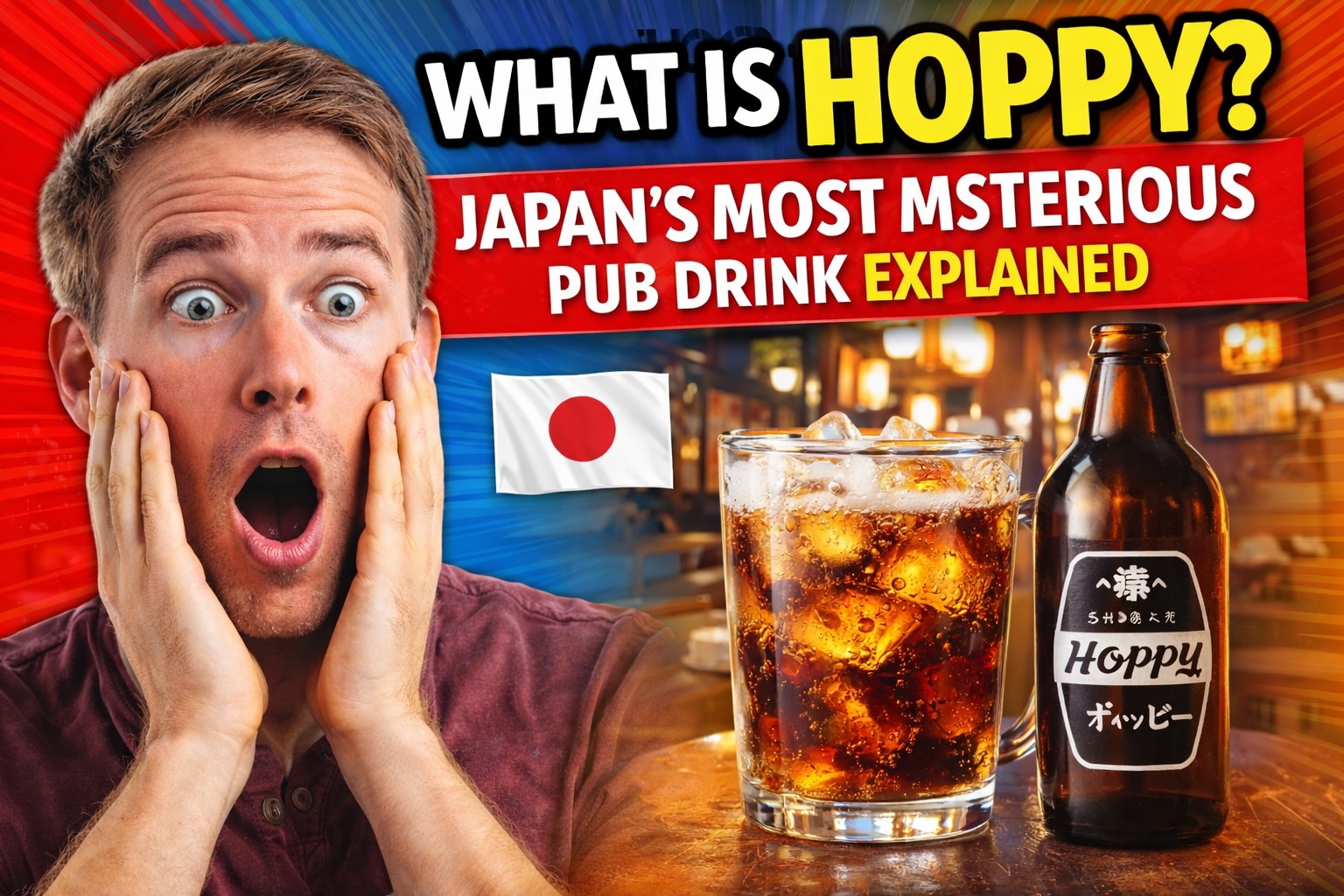
If you visit a traditional Japanese izakaya, you might see something that looks like beer — but isn’t.
It’s called Hoppy (ホッピー).
And for many people outside Japan, it’s one of the most confusing drinks on the menu.
So what exactly is it?
🍺 First of All — Hoppy Is Not Beer
Despite its appearance, Hoppy is not beer.
Hoppy is a low-alcohol, beer-flavored carbonated beverage originally created in 1948, during a time when beer was expensive and hard to obtain in post-war Japan.
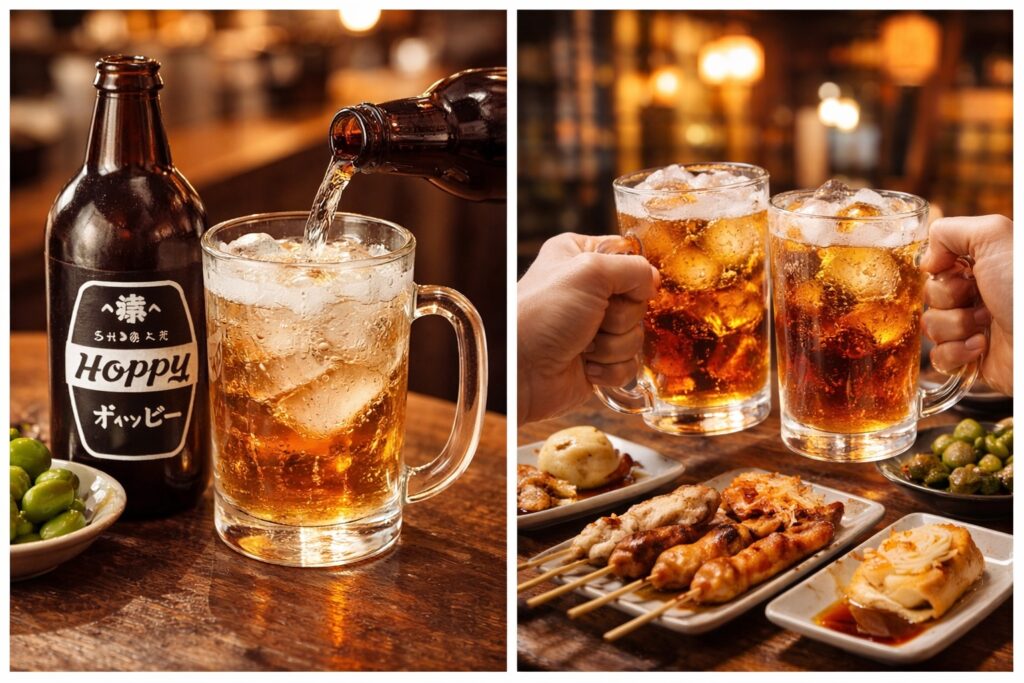
Instead of drinking beer, people mixed Hoppy with shochu (Japanese distilled spirit).
Even today, that’s how it’s typically served:
- A bottle of Hoppy
- A glass with shochu and ice
- You pour and mix them yourself
Exchange rate reference:
1 USD ≈ 150 JPY (Jan 2026)
Typical prices at izakaya:
- Beer: ¥500–700 ($3.30–4.70)
- Hoppy set: ¥400–600 ($2.70–4.00)
- Extra shochu refill (“naka”): ¥200–300 ($1.30–2.00)
It’s generally cheaper than beer.
🤯 My First Experience: “This Is Terrible”
I first tried Hoppy in my late 20s.
My honest reaction?
“This is terrible.”
I had expected something like beer.
But Hoppy is not beer.
It doesn’t have the same richness, depth, or smooth finish. If you think of it as a beer substitute, it feels thin and strange.
But that was my mistake.
Hoppy isn’t meant to replace beer.
It’s meant to be enjoyed as a shochu mixer with its own character.
🍶 Now? I Love It.
Over time, my perception completely changed.
Now I genuinely love Hoppy — especially Black Hoppy (黒ホッピー).
Compared to the white version, black has:
- Slightly stronger bitterness
- A deeper roasted flavor
- A more satisfying sharpness
Because you control how much shochu you pour, you can adjust the alcohol strength.
Personally, I enjoy it a bit stronger.
It’s refreshing, dry, and surprisingly easy to drink.
Unlike beer, I don’t get tired of it. I can keep drinking it all night without feeling heavy.
🥩 What Food Does It Pair With?
In my experience, Hoppy works especially well with oily or rich dishes.
I usually drink it at small, independently owned izakaya rather than chain restaurants.
It pairs particularly well with:
- Fried foods
- Grilled meat
- Stews
- Offal dishes
The strong carbonation cuts through grease nicely, which makes it satisfying with heavier food.
👴 Who Drinks Hoppy?
Here’s something interesting:
You rarely see young people drinking Hoppy.
In fact, I almost never see it ordered by people in their 20s.
It’s much more common among:
- Middle-aged salarymen
- Long-time regulars at old-school izakaya
- People who grew up during Japan’s high-growth era
Hoppy has a strong “Showa-era” (mid-20th century) nostalgia feeling.
For younger generations, sweet canned cocktails, highballs, or craft beer are usually more popular.
📜 Why Was Hoppy Created?
Hoppy was invented after World War II when beer was expensive and heavily taxed.
It allowed people to:
- Drink something beer-like
- Control alcohol strength
- Spend less money
That practicality is still part of its appeal today.
It represents a certain working-class pub culture in Japan — especially in Tokyo’s older neighborhoods like Asakusa or Ueno.
⚖️ Beer vs Hoppy — Don’t Compare Them
One important rule:
Do not compare Hoppy to beer.
If you expect beer, you will probably be disappointed.
Think of Hoppy as:
- A customizable mixed drink
- A crisp, dry alternative
- A cultural experience
Once you stop comparing it, it becomes much more enjoyable.
🇯🇵 So… Should You Try It?
Yes — at least once.
Not because it’s “better” than beer.
But because it’s uniquely Japanese.
Hoppy tells a story about:
- Post-war Japan
- Budget-conscious drinking culture
- The evolution of izakaya life
And who knows?
You might hate it the first time.
Like I did.
But you might also grow to love it.