
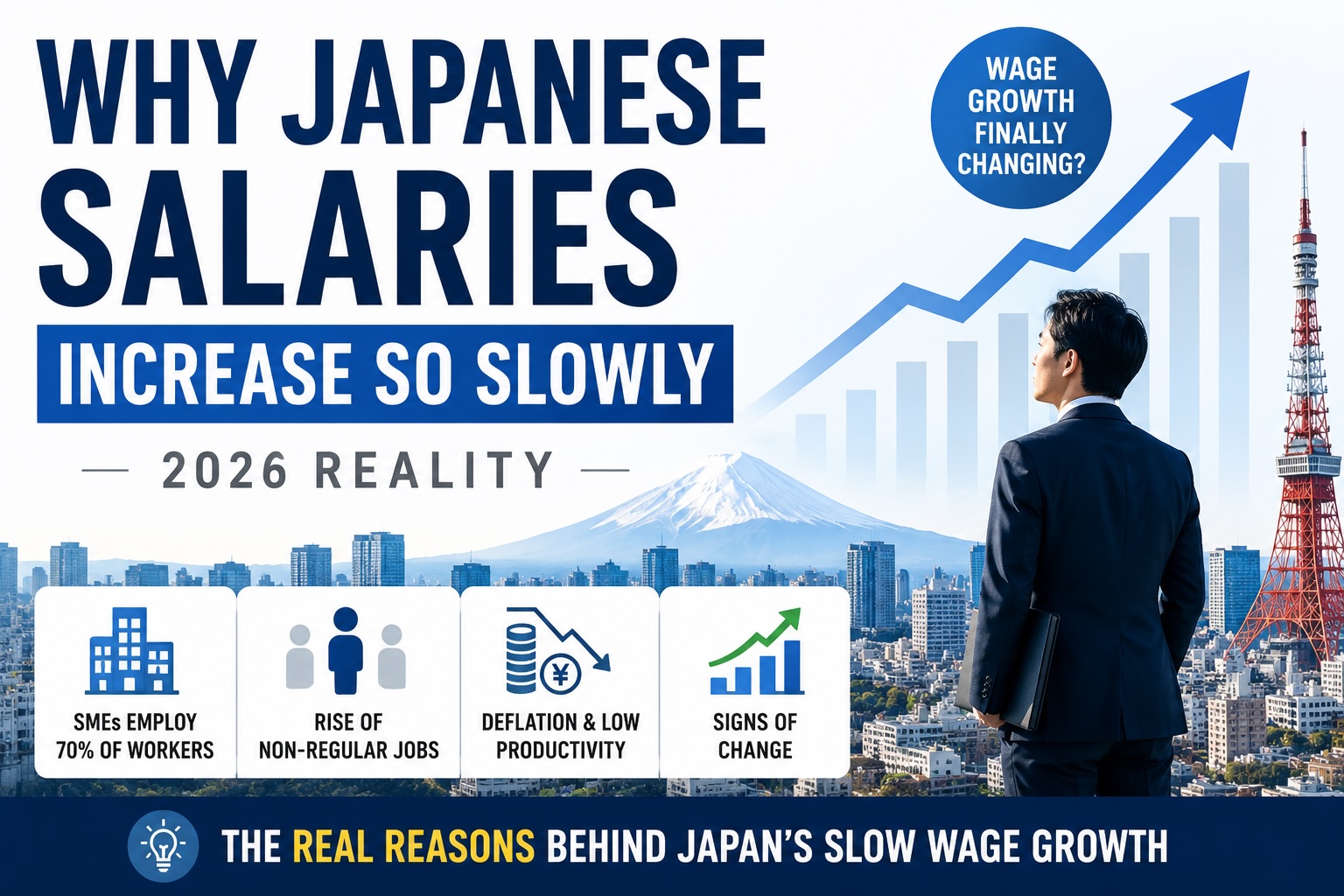
For many foreigners living in Japan — or thinking about moving here — one question appears again and again:
“Why do salaries in Japan rise so slowly?”
At first glance, Japan looks like a wealthy country.
- Cities are clean
- Public transportation works well
- Restaurants are affordable
- Convenience stores are efficient
But when people look at actual salaries, many are surprised.
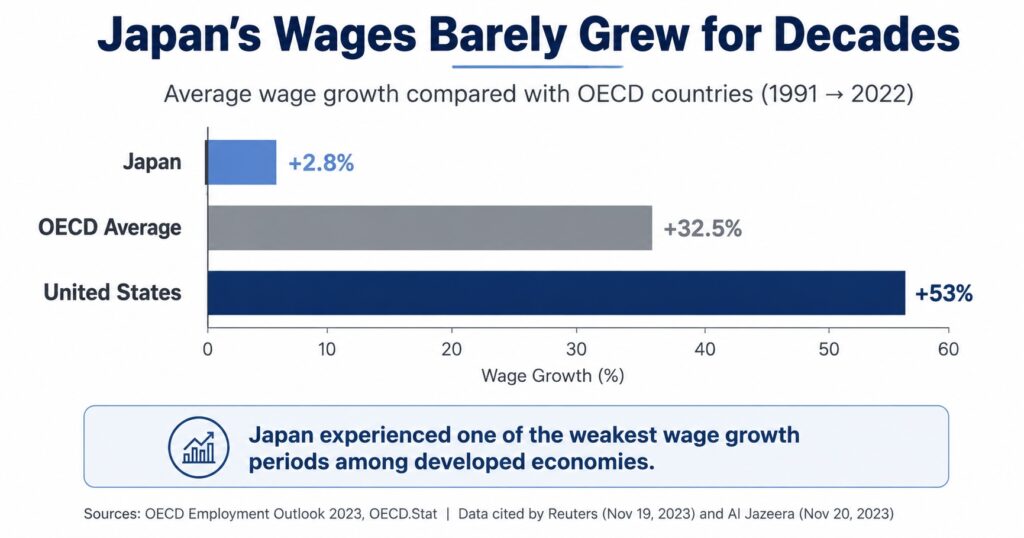
In reality, Japan experienced decades of weak wage growth compared to many other developed countries.
Even today, many workers still feel that salaries are not increasing fast enough to offset rising living costs.
Japan Experienced Decades of Wage Stagnation
Japan’s wage problem did not begin recently.
After the collapse of the bubble economy in the early 1990s, Japanese companies became extremely cautious about increasing labor costs.
For many years:
- Inflation stayed extremely low
- Economic growth slowed
- Companies prioritized stability over aggressive expansion
As a result, wages barely increased for decades.
This long stagnation became one of the defining characteristics of Japan’s post-bubble economy.
Related: Japan vs US Salary Structure
Companies Prioritized Stability Over Higher Pay
One major difference between Japan and countries like the United States is corporate culture.
Many Japanese companies traditionally prioritized:
- Long-term employment
- Stable operations
- Avoiding layoffs
This helped Japan maintain relatively low unemployment for many years.
But there was a trade-off:
Slower salary growth.
Instead of rapidly increasing wages during good years, companies often preferred to:
- Retain workers
- Build cash reserves
- Reduce risk during downturns
This conservative approach became deeply rooted after the economic shocks of the 1990s.
Deflation Changed Corporate Behavior
For many years, Japan struggled with deflation or near-zero inflation.
This had a major psychological effect on the economy.
In countries with steady inflation, workers and businesses usually expect salaries to rise regularly.
Japan was different.
Because prices barely moved for decades:
- Consumers became extremely price-sensitive
- Companies feared raising prices
- Businesses hesitated to raise wages aggressively
Even profitable companies often remained cautious about permanent salary increases.
This “deflation mindset” is still frequently discussed by economists and the Bank of Japan today.
Productivity Growth Has Been Relatively Weak
Another major factor is productivity.
In simple terms:
Sustainable wage growth usually depends on productivity growth.
Japan has many advanced global companies, but overall productivity growth has been relatively slow compared to some other developed economies.
Several structural issues contributed to this:
- Aging demographics
- Slow digital transformation
- Many small low-productivity firms
- Conservative business practices
The Japanese government itself now considers productivity improvement a major national issue.
Small Businesses Employ Most Workers in Japan
This is a very important point that many foreigners do not realize.
Small and medium-sized enterprises (SMEs) employ around 70% of Japan’s workforce.
Many of these businesses operate with:
- Thin profit margins
- Rising labor costs
- Limited pricing power
- Increasing material costs
Large corporations may be able to raise salaries more aggressively.
Smaller companies often cannot.
This weakens overall wage growth across the economy.
Non-Regular Employment Increased Dramatically
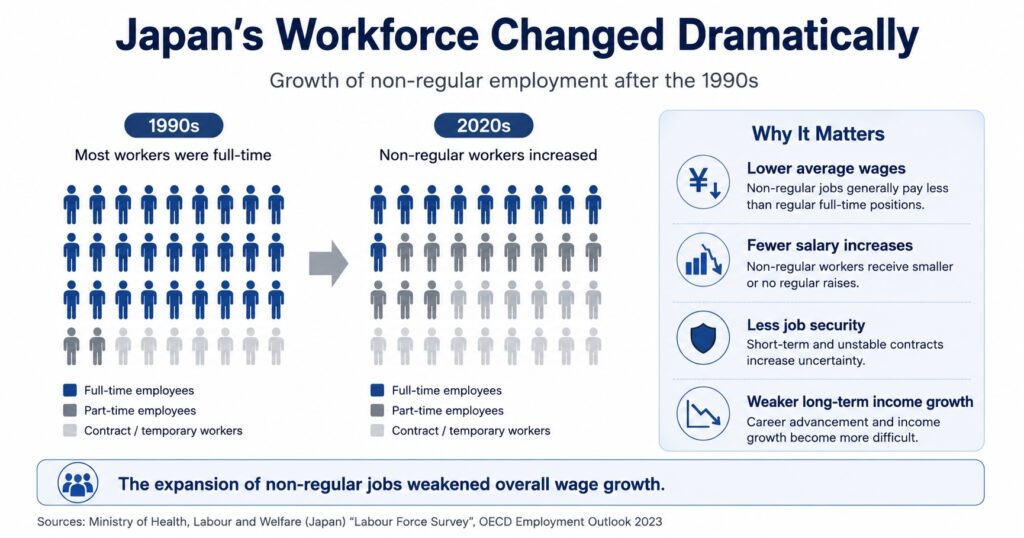
Japan also saw a major rise in non-regular employment after the 1990s recession.
This includes:
- Part-time workers
- Temporary workers
- Contract employees
These positions often provide:
- Lower wages
- Fewer raises
- Weaker job security
- Limited career progression
During Japan’s “Employment Ice Age” period after the bubble collapse, many younger workers struggled to obtain stable full-time employment.
As non-regular employment expanded, overall wage growth slowed.
Related: Average Salary in Japan’s Manufacturing Industry (2026)
Real Wages Are Still Under Pressure
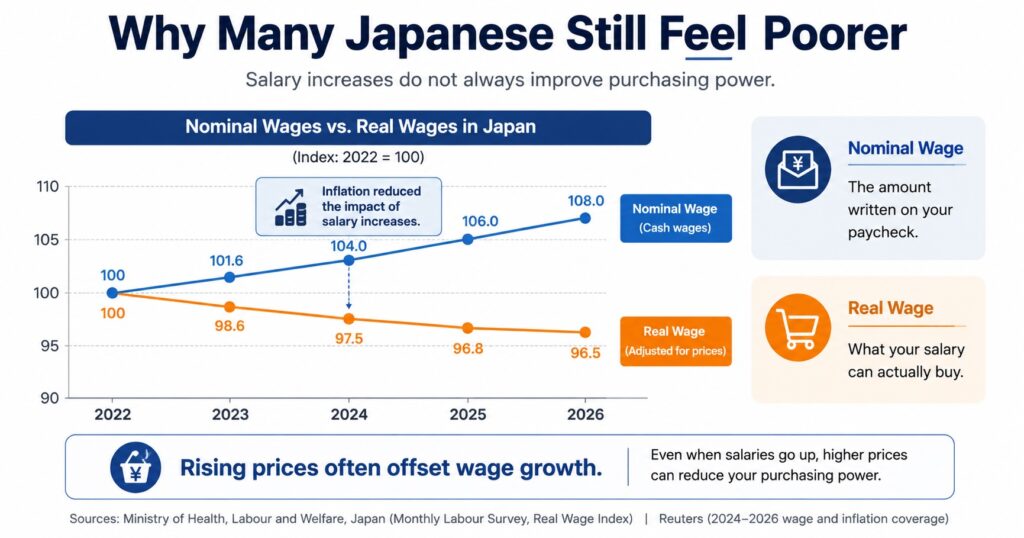
Recently, Japan has finally started seeing stronger nominal wage increases.
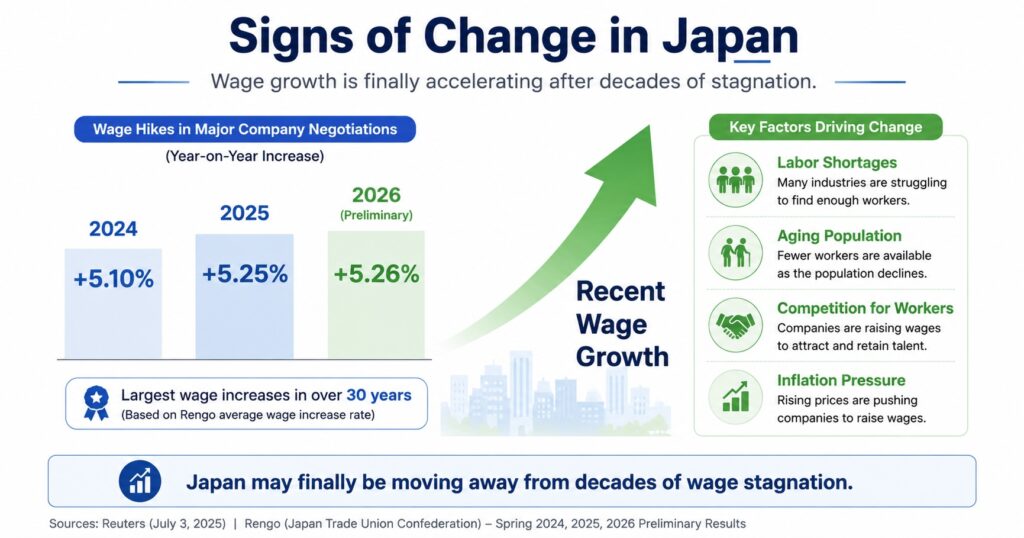
Large Japanese companies agreed to some of the biggest wage hikes seen in decades during recent labor negotiations.
However, there is an important problem:
Inflation
Even though salaries are rising nominally, inflation-adjusted real wages often remain weak.
For ordinary workers, purchasing power matters more than headline salary growth.
This is why many Japanese households still feel financially pressured despite recent wage increases.
Related: Why Bonuses Matter More Than Salary in Japan
Labor Shortages Are Finally Pushing Wages Higher
Japan’s aging population is now creating severe labor shortages.
This may become one of the biggest turning points in Japan’s wage story.
Companies increasingly struggle to recruit workers, especially in:
- Retail
- Restaurants
- Logistics
- Healthcare
- Manufacturing
As competition for workers increases, more companies are being forced to raise wages.
This is one reason why salaries have recently started moving upward after decades of stagnation.
Japan May Finally Be Changing
Japan appears to be entering a transition period.
Several forces are now pushing wages upward:
- Labor shortages
- Inflation
- Government pressure
- Competition for workers
- Changing public expectations
At the same time, structural challenges remain:
- An aging society
- Weak productivity growth
- Pressure on small businesses
- Slow economic expansion
Because of this, many economists believe wage growth in Japan will improve gradually rather than suddenly.
Final Thoughts
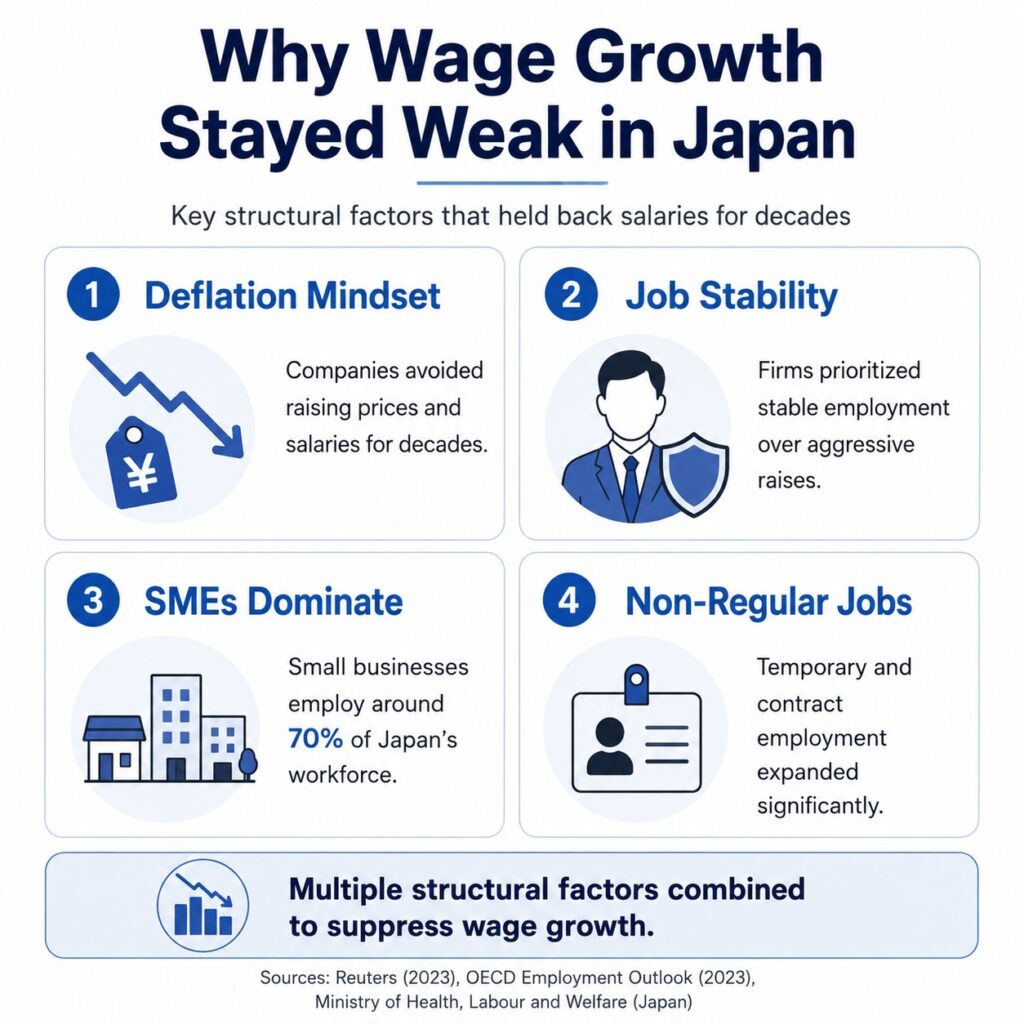
Japanese salaries increase slowly because several long-term structural factors combined together:
- Decades of deflation
- Conservative corporate culture
- Slow productivity growth
- Expansion of non-regular employment
- Pressure on small businesses
- Aging demographics
For many years, Japan prioritized stability over aggressive wage growth.
That system helped create:
- Relatively low unemployment
- Social stability
- Affordable daily life
But it also contributed to weaker salary growth compared to many Western countries.
Now, Japan may finally be entering a new phase — but whether wage growth can sustainably outpace inflation remains one of the country’s biggest economic questions.
Related Articles
- Average Salary in Japan’s Manufacturing Industry (2026)
- Japan vs US Salary Structure
- Who Can Save Money More Easily in Japan?
- Why Bonuses Matter More Than Salary in Japan
- Is Fukuoka Cheaper Than Tokyo?
Sources
- Reuters wage and inflation coverage
- Bank of Japan statements
- OECD wage trend data
- Japanese labor market statistics